
TRADE DESK NOTE
How to Approve Shantou Toy Assortment Accessories
Build a controlled accessory list for Shantou toy assortments with catalog comparisons, approve/hold/exclude decisions, owners, and closure conditions.
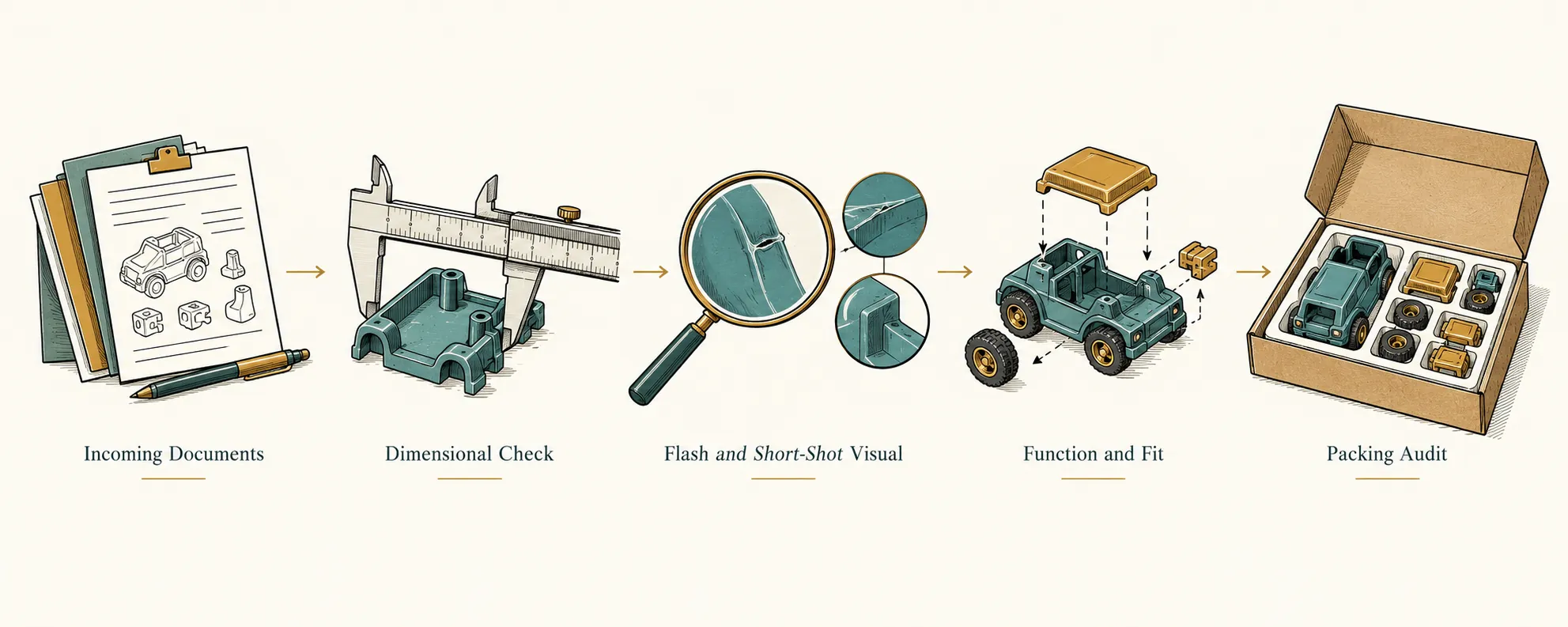
Choose pull-string and busy-board candidates for a hand-play accessory brief, and exclude RC vehicles when vehicle play is outside that brief. When buying from a Shantou toy manufacturer, approve each accessory against a controlled list that ties its mechanism and intended use to a reviewed sample, agreed packaging, current MOQ, delivery window, and destination-market documents. Keep a candidate on hold until named questions are resolved; exclude it when its play role misses the brief. A catalog listing alone is not approval.
What exactly should the accessory list control?
The accessory list should control which individual products may enter the assortment, in which specified configuration, and under whose approval. Here, “accessory” means a companion product added to an assortment—not a replacement part claimed to fit another toy.
Start with the play action. A pull-string phone-shaped toy offers a different interaction from a busy activity board, while a gesture-controlled stunt car introduces vehicle-control play. Shared catalog words such as “sensory” or “educational” do not make these interchangeable.
For the worked example below, the proposed buying brief is a compact hand-play accessory selection within the baby-and-toddler family, with travel as the intended use scene and no RC vehicle slot. This is an assortment target, not an age-suitability finding. Confirm the intended age range and use instructions before approval; do not adopt an infant age claim simply because it appears in a product name.
When should an accessory be approved, held, or excluded?
Approve an accessory only when the specified mechanism, intended age and use, sample configuration, packaging, commercial terms, and destination-market review have been accepted by the responsible buyer and reviewers.
Use Hold when the product could fit but a consequential question remains open. Name the question and its closure condition: for example, “Confirm the exact activities and component materials against the sample,” rather than “Await information.” A hold is not a finding that the product is unsafe or that the supplier cannot supply it.
Exclude a candidate when its mechanism falls outside the buying brief, or when an unresolved condition cannot be closed within the buyer’s decision window. Record whether exclusion concerns assortment fit or an unresolved approval condition. Do not turn a fit decision into a claim about product quality.
Controlled Accessory List CAL-01, Revision 0
CAL-01 provisionally retains two hand-play candidates on Hold, holds CPS191290 pending identification, and excludes the RC car because vehicle play is outside the proposed brief. These are illustrative screening decisions, not completed sample approvals or actual purchasing commitments.
The available catalog observations below are dated October 9, 2026. Review and decision dates of October 27, 2026 are illustrative; November 3, 2026 is a proposed buyer information-return deadline, not a supplier lead-time promise. Each row records its target, catalog observations, status, decision basis and date, approval specification/version, next action, owner, and closure condition. CAL-01/r0 identifies this worksheet revision, not an approved product specification.
No product fields for the required reference CPS191290 are supplied here. Obtain its matching entry from the corrected 25-reference Shantou-Toys catalog snapshot before comparing its mechanism or commercial terms. The available entries do not establish that all 25 references have been reviewed. Catalog records support identification and follow-up; they do not establish age suitability, certification, stock, or factory capacity.
| Rabbit phone-shaped pull-string toy — catalog reference CPS286416-CPS286415 | Record: CAL-01/r0; review date: 2026-10-27. Target: compact pull-action companion for the hand-play brief, subject to age/use review. Catalog observation: pull-string fidget mechanism; material field ABS; packing single item; reference MOQ 360 units. Units per carton: not recorded, therefore open. Decision: HOLD. Decision basis: the named mechanism fits provisionally, but sample configuration, age/use assessment, packaging, and order terms require acceptance. Decision date: illustrative 2026-10-27. Approval specification/version: none approved; catalog snapshot 2026-10-09 is the screening reference only. Before approval, record the accepted product specification revision, sample identifier/version, and packaging revision. Next action: request the exact sample and component/material description; confirm packing format, units per carton, current MOQ and quote, sample dispatch arrangements, delivery window, intended age/use evidence, and documents applicable to this SKU and the buyer's selected destination market. Owner: sourcing buyer; age/document review: designated product-safety reviewer; final sign-off: assortment buyer. Information due: proposed 2026-11-03. Closure: record actual sample observations separately from the target, resolve the named commercial and document questions, and obtain reviewer acceptance and assortment-buyer sign-off on a revised list identifying the accepted specification and sample. Approval remains withheld. |
|---|---|
| Sensory busy activity cube/board — catalog reference TL2022 | Record: CAL-01/r0; review date: 2026-10-27. Target: compact activity-based companion for the same hand-play brief, subject to age/use review. Catalog observation: busy activity cube/board description; color-box packing; reference MOQ 288 units; 96 units per carton. Material and dimensions: not recorded, therefore open. Decision: HOLD. Decision basis: the activity format fits provisionally, but the exact functions, materials, size, and intended use need sample review. Decision date: illustrative 2026-10-27. Approval specification/version: none approved; catalog snapshot 2026-10-09 is the screening reference only. Before approval, record the accepted activity/component specification revision, sample identifier/version, and pack-artwork revision. Next action: request the exact sample, activity/component list, material description, dimensions, and pack artwork; reconfirm current MOQ and quote, sample dispatch arrangements, delivery window, intended age/use evidence, and documents applicable to this SKU and the buyer's selected destination market. Owner: sourcing buyer; age/document review: designated product-safety reviewer; final sign-off: assortment buyer. Information due: proposed 2026-11-03. Closure: document the observed activities and dimensions against the target; accept the age/use assessment, packaging, commercial terms, and destination-document review; then obtain assortment-buyer sign-off on a revised list identifying the accepted specification and sample. Approval remains withheld. |
| Gesture-sensing RC stunt car — catalog reference CPS289538 | Record: CAL-01/r0; review date: 2026-10-27. Target: hand-play accessories without a vehicle-control slot. Catalog observation: 1:12 gesture-sensing, 2.4 GHz, four-wheel-drive RC stunt-car description with lights and music; packing single item; reference MOQ 24 units; 24 units per carton. Decision: EXCLUDE from this brief. Decision basis: the vehicle-control mechanism does not serve the selected assortment role, despite the lower reference MOQ. Decision date: illustrative 2026-10-27. Approval specification/version: not applicable—no product approval granted; exclusion is against the CAL-01/r0 hand-play brief, using catalog snapshot 2026-10-09 for mechanism identification. Next action: remove from this accessory selection; do not initiate sampling under CAL-01. Responsible reviewer and closure owner: assortment buyer. Illustrative closure date: 2026-10-27. Closure note: no further action under this brief; reopen only if the buyer authorizes a separate RC assortment brief. This exclusion makes no safety or quality judgment. |
| Product identity pending — required catalog reference CPS191290 | Record: CAL-01/r0; review date: 2026-10-27. Target: assess whether the exact product's mechanism and intended use fit the compact hand-play accessory brief. Catalog observation: no matching product entry supplied here; mechanism, assortment family, material, packing, reference MOQ, and units per carton remain unverified. Decision: HOLD. Decision basis: the SKU alone does not establish product identity or assortment fit. Decision date: illustrative 2026-10-27. Approval specification/version: none approved; matching catalog entry, product specification, and sample identifier/version remain pending. Next action: obtain the CPS191290 entry from the corrected 25-reference snapshot and confirm its identity with the supplier; record its exact mechanism, material, packing, MOQ, and carton quantity, marking absent fields as open. If the mechanism fits, request the exact sample, current quote, intended age/use evidence, sample dispatch arrangements, delivery window, and documents applicable to this SKU and the buyer's selected destination market. Owner: sourcing buyer; age/document review if retained: designated product-safety reviewer; final decision: assortment buyer. Information due: proposed 2026-11-03. Closure: establish product identity and record the mechanism-based fit decision. Exclude if it misses the brief; retain on Hold if consequential fields remain unresolved; approve only after sample, specification, packaging, commercial terms, and destination review are accepted and identified in a revised list. Approval remains withheld. |
Which comparison should determine the next sample request?
Choose the pull-string candidate for sampling when a single pull-action interaction is the intended assortment role; choose the busy-board candidate when a multi-activity format is the target. Neither should be approved for the intended age group from its catalog description alone.
The commercial comparison is specific: the pull-string candidate has a reference MOQ of 360 and a single-item packing entry; the busy-board candidate has a reference MOQ of 288, color-box packing, and a recorded carton quantity of 96. That makes the busy-board entry more explicit about packaging, not automatically more suitable for the buyer.
Treat “single item” as a packing entry, not confirmation of a retail box or a complete shipping specification. Likewise, 96 units per carton describes packing; it does not establish an order multiple. Request the current order restrictions directly.
The ABS field on the pull-string candidate does not describe every string, attachment, or other component. Review the component description alongside the physical sample rather than extending one material entry to the whole product.
How do you close a hold and hand off the approved list?
Close a hold by matching an identified sample and supporting records to the specified target, then recording the responsible approval—not merely by receiving an email attachment.
For the pull-string sample, document the actual pull action, string travel, accessible ends and attachments, dimensions, and agreement with the proposed configuration. For the busy-board sample, identify the activities actually present, moving or removable components, dimensions, and what the color box contains. These are purchasing observations, not substitutes for safety testing.
Request a dated quote identifying the exact item, quantity, packing, and commercial conditions. Record the sample version, dispatch and review milestones, proposed goods-ready date, and required arrival date separately. Have the supplier confirm the delivery proposal rather than treating a catalog entry as stock or schedule confirmation.
For the selected destination, request the applicable product-specific test reports and conformity or certification documents for review. Match model identity, photographs, construction, materials, age grading, and the scope of the documents to the proposed item. Record the reviewer’s conclusion; the presence of a document is not itself an approval.
Issue the next list revision with the accepted specification and sample identifiers, target versus observed results, final status, any remaining commercial conditions, responsible approver, approval date, and follow-up closure reference. Keep held items out of the approved purchasing list. Require review of proposed changes to components, mechanism, packing, or labeling after sign-off. This record supports traceability; it cannot by itself reveal an undisclosed change.
Next step