
TRADE DESK NOTE
How to Compare Price Units in Shantou Toy Assortments
Use a price-unit worksheet to align toy contents, retail packs, MOQ tiers, carton quantities, and delivery costs before comparing Shantou quotes.
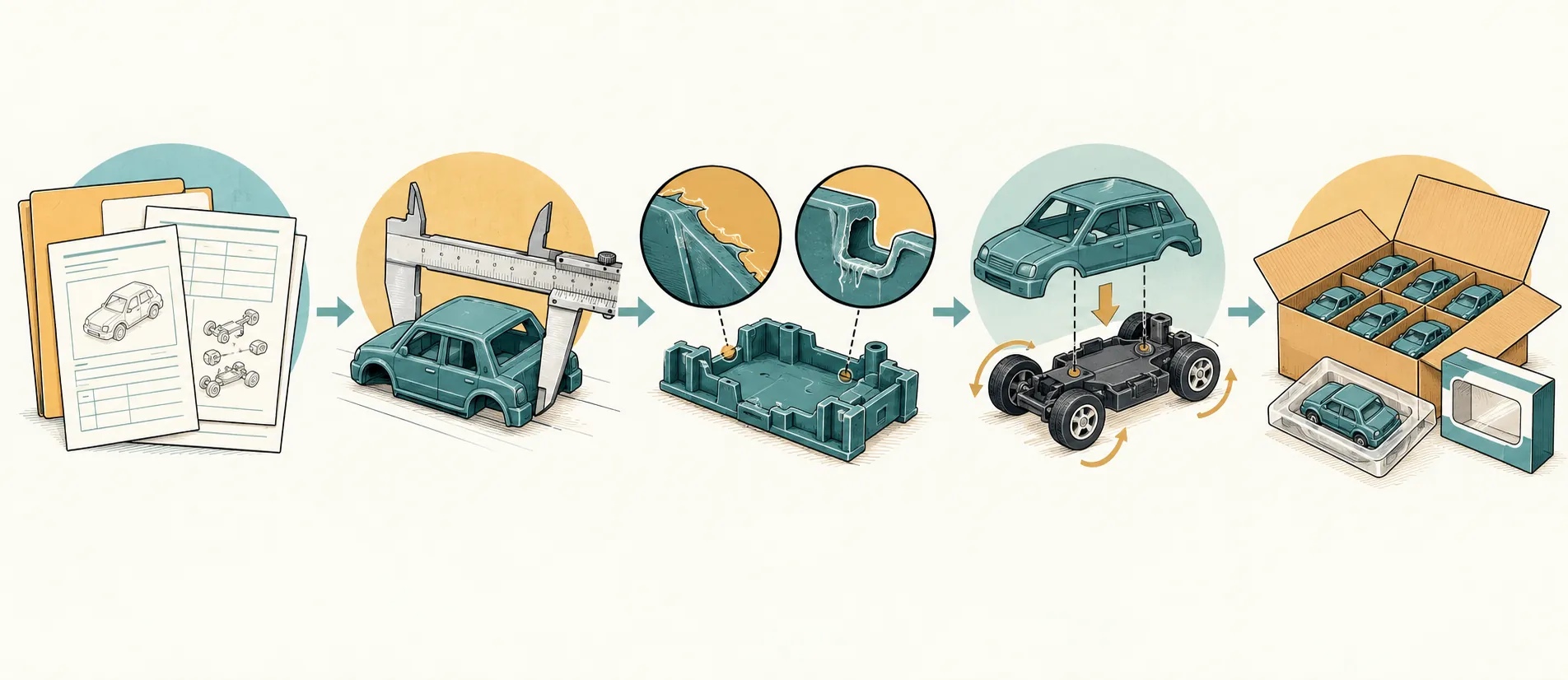
For Shantou toy assortments, compare prices per agreed saleable toy or complete kit—not per loosely defined “piece”—after matching contents, quantity tier, packaging, and delivery scope. A DIY miniature bathroom kit and a bedroom kit may share a reference price without being substitutes. Before ranking a Shantou toy manufacturer’s quote, record what one priced unit contains, the minimum that earns that price, and which packing, sampling, and delivery charges are included.
Keep the catalog reference beside the current quotation, not in place of it. Obtain a dated quote tied to the exact specification and order quantity before treating a reference price as a purchasing price. Shantou showroom guide
What belongs on the price-unit comparison worksheet?
| Item identity and revision | Record the buyer’s item identifier, supplier model reference, product image, specification revision, quotation number, quotation date, and validity period. Link any approved sample to that same revision. |
|---|---|
| Mechanism and intended use | Specify the play action, such as assembling miniature furniture, the intended assortment role, target age positioning, and included components. Identify acceptable differences before comparing alternatives. |
| Retail selling unit | Define whether the price buys one toy, one complete kit, a multipack, or a display. Record toys or complete kits per priced unit, retail packaging, instructions, artwork, and labeling work included. |
| Inner pack and export carton | Request retail selling units per inner pack and per export carton, plus carton dimensions and gross weight for freight comparison. Confirm whether mixed designs use the same packing configuration. |
| Price and currency | Preserve the supplier’s original price and denominator. Add a separate normalized price per agreed selling unit. Record currency, payment terms, and any exchange rate and date used for comparison. |
| Quantity and MOQ basis | Record the intended order quantity, the minimum quantity for the quoted price, whether that minimum applies per model, color, pack design, or total assortment, and any separate order-multiple restriction. |
| Assortment composition | List the quantity of each design or variant. Confirm whether the quoted price applies to the buyer-selected mix or only to a supplier-selected assortment. |
| Sample path and separate charges | Request sample specification, sample price, courier charge, approval sequence, and any agreed sample-credit terms. Separate artwork, tooling, packing setup, and other one-time charges from recurring goods prices. |
| Delivery scope and window | Record the delivery term, named place or port, included logistics services, quoted dispatch window, transit assumption, and buyer’s required arrival window. State the event from which any production lead time starts. |
| Destination-document scope | Identify the destination and request the model-specific reports, age-grading support, instructions, and label versions needed for purchasing review. Record which document review, testing, translation, or labeling charges are included in the offer. |
| Decision and closure | Record comparability status, conditions or exceptions, responsible buyer or approver, decision date, and the owner and due date for each follow-up. Close each condition against a revised quote, specification, or other relevant confirmation. |
Are the bathroom and bedroom miniature-kit prices comparable?
| DIY miniature bathroom furniture kit | Recorded material: plastic. Recorded packing: color box. Reference MOQ: 10. Recorded units per carton: 48. Reference price: USD 3.10. Comparison request: identify the contents of one complete kit and confirm the quoted price per complete retail-box kit at the intended quantity. |
|---|---|
| DIY miniature bedroom furniture kit | Recorded material: plastic. Recorded packing: color box. Reference MOQ: 10. Recorded units per carton: 48. Reference price: USD 3.10. Comparison request: confirm the bedroom-kit contents and quote the same retail-box, quantity, and delivery basis used for the bathroom candidate. |
| Assortment selection decision | Treat the two room themes as separate assortment lines. If both themes are wanted, compare supplier offers within each line. If selecting only one theme, evaluate the contents and assortment role as well as the normalized price. |
How do you convert a carton, set, or piece price to one basis?
Divide the quoted amount by the confirmed number of agreed selling units that amount buys; preserve the original quotation beside the result.
For a carton quote, normalized goods price per complete kit = quoted carton price ÷ confirmed complete kits per carton. For a multipack quote, divide by the confirmed complete kits in that multipack. Do not divide a kit price by its furniture-piece count unless individual furniture pieces are genuinely the product you intend to purchase and sell.
The recorded carton quantity of 48 for the miniature-room examples is a packing reference, not permission to assume that every future carton configuration is identical. Have the supplier confirm it against the quoted specification before using it as a divisor.
Keep MOQ and order multiples separate. A minimum answers how much must be ordered; a multiple controls permitted quantity increments. Neither a reference MOQ of 10 nor a carton quantity of 48, by itself, establishes a full-carton purchasing restriction. Ask whether partial cartons and mixed-design cartons are accepted and whether they change the price.
Quantity normalization also has a limit: a quote earned at a larger commitment is not an equal alternative to a quote at your intended order size. Request both offers at the same quantity and variant mix, or show the different commitments explicitly rather than presenting the lower figure as a like-for-like saving.
Which costs should sit beside the normalized goods price?
Keep the recurring goods price separate from one-time charges and delivery costs, then compare totals at the same quantity and destination.
Use this calculation: comparison cost per agreed selling unit = (goods total + confirmed excluded charges within the chosen comparison scope) ÷ confirmed selling units ordered. Add only costs not already included in the quotation. A freight charge must not appear once inside the quoted total and again as an adjustment.
Show sample, artwork, tooling, and setup charges separately. If allocating them across the initial order, label that result as an initial-order cost—not as the recurring reorder price. Apply any sample credit only when its terms are agreed.
A delivery comparison needs more than a shipping label. Record the named place, transport mode, included freight and handling, and the treatment of duties and taxes. Keep the dispatch window distinct from the required arrival window.
Destination-document work belongs beside the price only to clarify the purchasing scope and its charges. Matching prices or packaging do not establish that two items have equivalent document coverage, and arithmetic normalization is not a safety or legal-compliance determination.
When is a quote ready to rank?
Rank an offer only when its price denominator and material purchasing conditions are explicit; otherwise retain it as a conditional option or return it for correction.
Use the following statuses for each item, not one blanket status for the whole assortment. A clear quotation for one toy does not resolve the price basis of another.
| Comparable | The agreed product specification, selling-unit contents, quantity tier, packing, currency, delivery scope, and relevant purchasing conditions align. Rank the offers on the stated comparison basis. |
|---|---|
| Conditionally comparable | The denominator is clear and the remaining difference can be isolated—for example, a separately priced artwork charge. Show the adjustment and its condition explicitly; do not treat a conditional shortlist as final purchase approval. |
| Not comparable | The denominator is ambiguous, the kit contents differ without an accepted alternative specification, or the quoted quantity or delivery scope cannot be reconciled. Request a corrected quotation naming the exact issue before ranking. |
| Approval and follow-up closure | Save the quotation and specification revisions used, the buyer’s target versus the supplier’s confirmed offer, the decision and conditions, the responsible approver, and the date. Record the revised evidence that closes each condition. This provides traceability; it does not by itself detect an undisclosed product change. |
Next step