
TRADE DESK NOTE
Shantou Private-Label Toy Artwork: Release or Hold?
Use a revision-linked artwork checklist for Shantou toy assortments, with supplier acknowledgement, first-off checks and separate batch-release decisions.
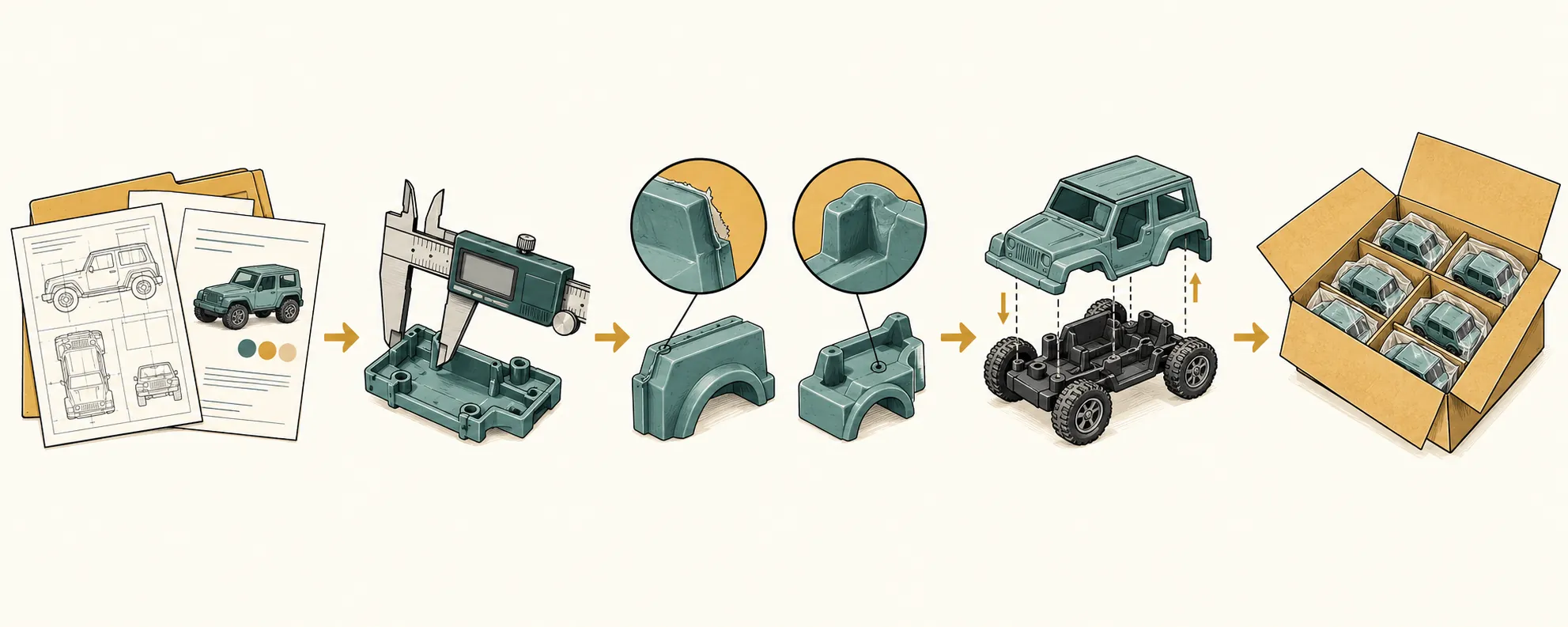
Release private-label artwork for a Shantou toy assortment only when the product configuration, packaging component and approved revision are identified; release the production batch separately after checking its printed output. With a private-label toy supplier in China, use one handoff worksheet per SKU, with component-level revisions, a dated supplier acknowledgement, an approved sample reference and recorded inspection results. A correct first-off supports the print setup—it does not establish that every packed unit carries the correct artwork.
Which product configuration should the artwork describe?
The artwork should describe the exact mechanism, contents and use configuration approved for that assortment line, not merely the product family or a shared brand design.
For example, a catalog-listed light-up capybara unicycle tumbler electric track toy has recorded packing of “single item,” a reference MOQ of 108 and a material field of “wooden.” Those fields are starting references: “single item” does not define a retail box or dieline, the material entry does not establish every component’s construction, and the reference MOQ does not establish the minimum for custom printing. Before approving its artwork, confirm the sampled mechanism, included track pieces and accessories, power instructions where applicable, and the actual packaging format.
Record the intended age and use scene, destination, current order quantity, custom-print minimum, sample route and delivery window. Request a digital proof followed by an agreed physical printed or packed sample before production release. Set approval deadlines against the supplier’s confirmed schedule rather than assuming an artwork change fits the existing delivery window.
Keep the product specification, sample identity and artwork revisions connected. This follows the controlled-product-identity approach described in the Shantou development guide. For destination-specific wording, have the responsible reviewer approve the exact text for that configuration; artwork approval is not a safety assessment.
What belongs in each SKU’s artwork handoff worksheet?
| Product and order identity | Enter the buyer item number, supplier item reference, product description, configuration revision, assortment line, purchase order and affected batch or production run. |
|---|---|
| Mechanism, contents and use | Specify the approved mechanism, included pieces and accessories, intended age and use scene, destination market and packaging language. Reference the approved product sample. |
| Commercial and sample boundary | Record the agreed order quantity, current product and custom-print minimums, packaging format, sample route, approval deadlines and confirmed delivery window. |
| Packaging component identity | Identify each box, hang tag, insert, instruction sheet, product label or carton mark. Link its artwork file to the correct SKU and dieline revision, including dimensions and substrate specification. |
| Released artwork target | Enter the artwork revision, exact filename, controlled file location, change description and superseded revision. Keep the released print file separate from editable drafts. |
| Approval and applicability | Record the buyer approver and approval date, then state the effective date and first affected order or batch. Specify how existing printed stock and work in progress are to be handled. |
| Approved reference set | Identify the digital proof, product sample and physical packaging or print sample used for approval. Record which reference governs content, dimensions, placement and color. |
| Supplier acknowledgement | Record the supplier representative, acknowledgement date, accepted revision and effective batch. Attach confirmation of the active print file and disposition of superseded files, plates and printed stock, as applicable. |
| First-off: target versus observation | State the required revision and sample reference, then record the actual printed result, discrepancies, photographs, checker and check date. Give a separate setup-release or hold decision. |
| Batch inspection record | Reference the inspected batch, artwork revision, component list, approved sample, inspection scope, actual findings, photographs and report identifier. State which units or lots the findings cover. |
| Release, hold or reject | Record the decision separately for artwork, print setup and production batch. Identify the authorized approver, decision date, affected quantity or lot and any conditions. |
| Corrective action and closure | Assign an action owner and due date. Record the correction, replacement proof or first-off, reinspection evidence, disposition of held stock, closure approver and actual closure date. |
What supplier acknowledgement is sufficient for printing?
Accept an acknowledgement that names the released revision, its effective date and the affected production run—not a reply that merely says the files were received. This is the distinction recommended in Eastar SCM’s revision-control guidance.
Use a direct request: “Confirm the SKU, packaging component, artwork revision, effective date and first affected batch. Identify who verified the active print file. Confirm that superseded files or plates are removed from active use, and state the disposition of existing printed stock and work in progress.”
Agree the responsibility split in the handoff: the buyer approves content and change timing; the supplier implements the released version in printing. Preserve superseded files as controlled history, not as selectable production files.
If the acknowledgement conflicts with the release record, hold the affected print instruction while reconciling the difference. That gap does not automatically invalidate an already inspected batch or prove the supplier used the wrong file; examine the physical output and other records before deciding its disposition.
What should the first-off and batch checks verify?
The first-off should verify the actual printed component against the released artwork and approved sample; the batch inspection should then check the identified production lot against the same references.
Compare product images and included contents, logo version, text and language, instruction sequence, label placement, dimensions and print orientation. Check barcode data and scan performance where a barcode is specified. Inspect the assembled package too: a correct flat proof can still place text across a fold or conceal it after packing. Record observations and photographs rather than writing only “artwork OK.”
Use agreed visual or measurement criteria for color, registration and placement. These are purchasing criteria, not toy-safety test standards. For report references associated with the package, compare the model, materials, components, age grade and destination scope with the current product; the Shantou development guide recommends this identity check before accepting a report.
Name the artwork revision in the inspection record. Without that reference, the record alone does not establish which version was checked, although retained samples, photographs and controlled files may provide additional evidence. For a held trial batch, require a verified first-off or first-article check rather than verbal reassurance, as recommended by Eastar SCM. Keep suspect printed stock segregated and identified by batch, revision and hold status while its disposition is decided.
When should the buyer release, hold or reject?
| Release artwork to printing | The configuration, component, file revision, approved references and effective batch are agreed, and the supplier acknowledgement matches. This does not release finished goods. |
|---|---|
| Release the checked print setup | The first-off matches the released revision and agreed sample criteria, with checker, date and evidence recorded. Continue with the agreed production and batch-inspection controls. |
| Release the identified batch | Revision-linked inspection supports acceptance under the agreed inspection scope, required corrective actions are closed, and the authorized buyer records the lot-specific decision. |
| Hold pending resolution | Use a hold when a revision conflict, unresolved discrepancy or incomplete verification prevents the next approval. State the affected scope, action owner and evidence needed to close it. |
| Reject the nonconforming component or lot | Record rejection when the checked output fails an agreed acceptance criterion and the authorized buyer declines the proposed correction or disposition. Identify the affected goods; do not automatically reject unrelated assortment lines. |
Worked Example: A Correct First-Off but Mixed Hang Tags
| Identity and change | Illustrative assortment line: light-up capybara track toy; buyer reference CAP-TRACK; trial batch T-01. Component: hang tag only. Revision B replaces Revision A’s logo; other packaging components remain unchanged. |
|---|---|
| Approved target and timing | Revision B file: CAP-TRACK_TAG_B.pdf; approved reference: tag sample TAG-B. Buyer packaging lead approves on October 20, 2026; effective from trial batch T-01 on October 21, 2026. |
| Supplier acknowledgement | Supplier print coordinator acknowledges Revision B and its effective batch on October 20, 2026, and confirms removal of Revision A from the active print queue. |
| First-off observation | October 21, 2026: the recorded first-off matches Revision B and sample TAG-B. Check reference FO-01 supports setup approval only. |
| Batch observation | October 22, 2026: inspection record INS-01 identifies both Revision A and Revision B tags in the inspected packed goods. Its photographs identify the differing logos. |
| Decision and approver | HOLD trial batch T-01. Buyer packaging lead records the decision on October 22, 2026. The approved artwork remains Revision B; the mixed batch is not released. |
| Action owner and deadline | Supplier packing lead to contain T-01, trace the old tag stock and submit a correction and reinspection plan by October 23, 2026. Buyer packaging lead must approve the proposed disposition. |
| Follow-up closure condition | The hold remains active until the agreed correction is completed and revision-linked reinspection supports acceptance. Attach the correction and inspection references, then record the buyer’s final decision, signature and actual closure date. |
What makes the handoff ready for final approval?
The handoff is ready when the approver can trace the exact SKU and packaging component from released file to acknowledged instruction, checked output and batch decision without guessing which revision applied.
Keep the worksheet and its referenced files together. A signed record supports traceability; it cannot by itself prevent an undisclosed substitution or prove that uninspected goods match. Close each hold against evidence, and release only the components and batches named in the decision.
Next step