
TRADE DESK NOTE
Custom Logo Placement on Toy Packaging: A Buyer Checklist
A buyer checklist for custom logo placement on toy packaging: exam documents, artwork and dieline proofing, sample approval, and the questions to ask before you commit.
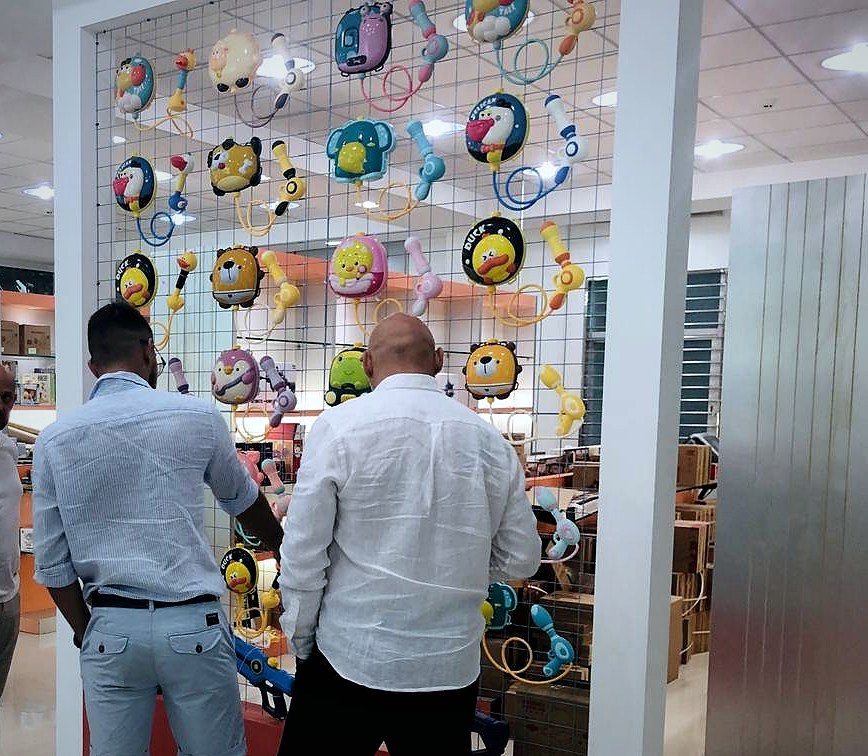
Custom logo placement on toy packaging is approved or rejected on documents and physical proofs, not on a supplier's promise. Before you contact a supplier or release a purchase order, lock four things: the artwork file and dieline, the physical proof of logo position and size, the compliance file for the exact model or SKU, and written confirmation of who owns the tooling and the approved specification. Everything else — unit price, carton count, lead time — is negotiable later; these four are not.
This page is built around the moment a shipment is pulled for inspection at the destination. That is when the logo placement you approved in an email, the label on the finished toy, and the paperwork in the file all have to agree. Below: the papers an officer asks for, a worked example of a shipment that gets held, and the questions to put in your RFQ before you commit.
Papers at the exam: what the officer asks for and what happens without it
| Product-specific conformity or test file matching the exact model/SKU | Why the officer asks: to confirm the product presented is the product covered. Where it should be: in the shipment file and with your freight forwarder. If you do not have it: the consignment can be held pending clarification, and a generic category name will not substitute. |
|---|---|
| Declaration or certificate naming the responsible party, model and dates | Why the officer asks: to identify who certifies and what was tested. Where it should be: with the compliance file, referenced by SKU. If you do not have it: a catalog symbol or a CE image alone does not establish the file exists. |
| Label and hang tag content: brand, care, material, country of origin, warnings | Why the officer asks: to check the physical marking against the declared product. Where it should be: sewn or printed on the finished toy, plus the hang tag. If you do not have it: mismatched or missing required marking is a detention trigger, and rework at the port is expensive. |
| Battery-access and warning marking, where a button or coin cell is present | Why the officer asks: coin-cell access and required warnings are a known enforcement area. Where it should be: on both the product and the packaging. If you do not have it: an easily accessible coin cell is a recall-class problem, not a paperwork fix. |
| Packaging artwork proof and approved dieline with the logo position marked | Why the officer asks: rarely, but your own QC needs it to verify the printed box. Where it should be: in the approved-specification pack, signed off before mass production. If you do not have it: you cannot prove the printed carton matches what you approved. |
| Incoterm and freight documents | Why the officer asks: to establish the transaction and responsible parties. Where it should be: with the commercial documents. If you do not have it: note that FOB, CIF or DDP allocate trade responsibilities but do not certify the toy or replace market evidence. |
Worked example (illustrative, not a real shipment)
A buyer orders roughly 2,000 units of a boxed plastic toy car, split between a US destination and an EU destination, with the same logo printed on the front panel of two different retail boxes. The factory sends one artwork proof for the shared front panel and reuses the same carton marking for both runs. Everything looks fine until the container is pulled.
At the exam, the officer matches the model reference on the box to the conformity file. The US-bound run carries a certificate that names the model; the EU-bound run was packed with the same outer carton but a different inner box and a different model suffix, and no matching file was ever requested for that suffix. That is the step where the shipment gets held: not the logo, not the print quality, but the model identity on the packaging no longer matching the document that is supposed to cover it.
The second failure is quieter. Because a single proof was approved for both boxes, the logo sits lower on the EU box than the buyer intended, and the care and warning text on the back panel was never re-checked after the panel dimensions changed. The buyer approved a flat artwork file, not the finished printed box. Two runs, one approval, and no one verified the label on the finished product rather than on a screen.
The fix is procedural and cheap: one proof per destination, one conformity file per model suffix, and a physical pre-production sample of the finished boxed toy reviewed in hand. The expensive version is the one where the container sits at the port while you email the factory for a document that was never issued.
What should the artwork file contain before you send it to a factory?
Send a vector logo file with defined dimensions and placement, not a logo image alone. A logo file without dimensions does not show intended label size, folding style, sewing allowance, or final position, and the factory will guess. Prepare AI, CDR or high-resolution PNG artwork, Pantone references for brand colors, and a mockup showing size and placement on the actual dieline.
Decide the placement location before you ask for a quote, because location changes the process and the process changes the cost. Common positions include the front or bottom panel, a hang tag, a woven or sewn label, a washable neck label, and the packaging box itself. On soft goods, embroidery usually caps out around twelve colors and handles gradients poorly, while printing covers full color and photo-quality artwork but may fade after long-term washing. On rigid boxes and cartons, print method and plate setup drive both unit cost and setup cost.
Ask for a color card comparison before production if brand color matters. Batch-to-batch variation in embroidery thread and printing ink is normal, and a Pantone reference in the file is the only reliable way to argue about it later.
How do you approve a logo placement without approving the wrong thing?
Approve the physical sample on the finished product, not the flat artwork. Stuffing, seam construction and box assembly change how a logo sits: a label that looks correct flat can appear too long, face the wrong direction, or land too close to a feature once sewn. On a printed box, the fold and the panel edge change the visible logo size.
Check the label and hang tag as a set: finished visible size, logo proportions, text spelling and readability, color, front-to-back direction, fold type, position, and stitching security. For hang tags, verify finished size and shape, paper thickness, front and back artwork, barcode and QR readability, hole position, and attachment method. Then confirm the product-to-SKU match — the tag on the toy must name the same item as the box and the file.
Write the acceptance criteria into the order, not into an email thread. Logo placement, process, color, dimensions, acceptance criteria and after-sales terms belong in the purchase contract or the order notes. Verbal agreements are the reason two people can look at the same carton and disagree.
What has to be confirmed before custom packaging goes into production?
MOQ is not one number. A molded-toy MOQ is a factory- and SKU-specific commercial term affected by resin, mold, decoration, packaging and production quantity, and it should not be treated as a universal industry figure. The toy factory may have one minimum, the packaging printer another, and a component or color supplier a third.
Before placing a personalized order, confirm the proofing cycle, the printing process limits and the packaging MOQ, then request the latest material test report so the ink and paper meet the target market's requirements. Packaging compliance responsibility ultimately sits with the toy brand or manufacturer; the packaging supplier supports at the material and process level. That division matters when a market asks who verified the printed ink.
Ask for a quote at several customization levels — standard product, logo-only, custom-package, modified product — so the cost of each branding decision is visible instead of buried in a single unit price.
Carton compression and stacking checks matter more once you add a printed retail box. Lower cartons that crush will damage the packaging you just paid to print, and the damage shows up at the destination, after the freight is already spent.
Which compliance documents must match the packaging you are printing?
Request the product-specific file for the exact model or SKU, and check that the model reference on the file matches the reference you are printing on the box. A certificate that describes the covered product must describe it well enough to match it to that product; a generic category name does not establish coverage of every catalog SKU. If you print a new model suffix on a custom box, you have created a new item that needs its own matching file.
Check the scope of the laboratory, not just the existence of a report. According to CPSC guidance, laboratory acceptance is specific to the relevant safety rules, and one laboratory may not cover every required test. For a toy RFQ, ask which accepted laboratory performed the testing and whether its scope covers every required test for this configuration, and ask who the certifier is, with test and manufacture dates.
Do not describe a product as approved by an EU authority because a CE string or image appears in a catalog. According to the European Commission, CE marking is the manufacturer's declaration and does not identify a product's origin; conformity assessment, the technical file, the declaration of conformity and affixing the mark sit with the manufacturer, while importers and distributors carry their own obligations. The practical ask is the product-specific file, not the symbol.
Battery access deserves its own gate. Where a button or coin cell is present, ask how the cell is secured against child access and what warnings appear on both the product and the packaging. A 2026 US recall of a prank sound maker turned on exactly this: an accessible lithium coin cell plus missing packaging and product warnings. Use it as a reason to ask the question, not as evidence about any particular SKU.
How do you keep the approved version from drifting after the order?
Put a change-notice clause in the order. A supplier should notify the buyer before changing resin, colorant, mold, process, component, sub-supplier or packaging that can affect the released toy. Custom packaging is exactly the kind of change that slips through: a new printer, a different board stock, a re-cut dieline. Without the clause, you find out at the port.
Keep the approved specification pack — artwork file, dieline, physical proof, color reference, label sample — and check production against it rather than against memory. Multi-cavity molds and multi-run print jobs both produce within-batch variation, which is why cavity identification and balance checks exist on the molding side and why a retained approved sample exists on the packaging side. One physical reference settles most arguments.
On the commercial side, quote packaging separately so a switch from a window box to a polybag, or from a printed carton to a plain one, shows up as a number instead of disappearing into the unit price. And before you send drawings, color standards or test requirements, put them under a non-disclosure and non-use agreement; a molder holding your tooling and artwork without a non-use clause is a commercial risk, not a legal formality.
What to ask suppliers before you commit (RFQ checklist)
Send the same brief to every supplier you shortlist and compare the answers line by line. Vague answers on documents are the signal to slow down, not the signal to negotiate harder on price.
| Can you provide the product-specific conformity or test file for this exact model or SKU, and which applicable rules does it reference? | Request the actual file, not a summary. Confirm the model reference matches what will be printed on the custom packaging. |
|---|---|
| Which accepted laboratory performed the testing, and does its scope cover every required test for this toy configuration? | Laboratory acceptance is rule-specific; one lab may not cover every required test. Ask for the scope, not just the report. |
| Who is the certifier or responsible party, and what are the test and manufacture dates? | The file should identify the responsible party, the test-record holder and the dates. A catalog mention is not the same as the record. |
| Does this SKU contain a button or coin cell, and what access prevention and warnings appear on the product and packaging? | Ask for photos of the finished product and the printed packaging showing the warnings in place. |
| For custom logo placement: what artwork format do you need, which positions and print methods are available, and how does color matching work? | Ask for the dieline, the available placements, the process limits, and whether a color card comparison is provided. |
| What is the proofing and approval cycle, and what does the pre-production sample include? | Confirm whether the sample is a stock item, a digital mockup, or a production sample using the intended material and decoration. These are different levels of evidence. |
| Confirm current MOQ, units per carton, carton dimensions and weight, packing type, and price for this SKU. | Ask for these in writing per SKU; a catalog-wide MOQ should not be assumed to apply to every item. |
| Will you notify us before changing resin, colorant, mold, process, component, sub-supplier or packaging? | Get this in the order terms. It is the clause that protects the approved version. |
| Can you quote the standard product, a logo-only version, a custom-package version, and a modified-product version separately? | Separating packaging from product exposes the real cost of each branding decision. |
| Which trade term applies, and how are freight and destination charges handled? | Remember that the Incoterm allocates trade responsibility; it does not replace market evidence or certify the toy. |
FAQ
Can a supplier's CE or CPC mention be treated as proof the toy is approved?
No. CE marking is the manufacturer's declaration and does not identify a product's origin, and a CPC must describe the covered product well enough to match it to that product. Ask for the product-specific file for the exact model or SKU and confirm the responsible parties and dates.
Does the logo file alone tell the factory what to produce?
No. A logo file without dimensions does not show intended size, folding style, sewing allowance or final placement, and the factory will guess. Send vector artwork with Pantone references plus a mockup showing size and position on the actual dieline.
Should I approve the artwork on screen or the physical sample?
Approve the physical sample on the finished product. Stuffing, seam construction and box assembly change how a logo sits, so a label or print that looks correct flat can sit wrong once assembled.
Is MOQ one number I can compare across suppliers?
No. Molded-toy MOQ is a factory- and SKU-specific commercial term affected by resin, mold, decoration, packaging and production quantity. The toy factory, the packaging printer and component suppliers may each carry a separate minimum.
What document request prevents a shipment being held at the port?
A product-specific file that matches the exact model reference printed on the packaging. If you print a new model suffix on a custom box, treat it as a new item and request the matching file before production.
Do Incoterms cover product compliance?
No. FOB, CIF, DDP and other Incoterms allocate trade responsibilities and risk transfer between seller and buyer; they do not certify the toy or replace CE, CPC, UKCA or other market evidence.
Sources
Ready to brief a supplier?
Send the same RFQ to every shortlisted factory and compare the document answers before you compare unit prices. If you need a starting point for the product side of the brief, our wholesale toy range covers boxed plastic and RC toys with OEM/ODM and low-MOQ options — confirm the current sample, quote, age evidence and destination documents for the exact SKU before you order.
Next step