
TRADE DESK NOTE
How to Approve Material Changes in Shantou Toy Assortments
Use a change-evidence worksheet to approve, reject, or conditionally approve toy substitutions against the agreed revision, sample, and destination.
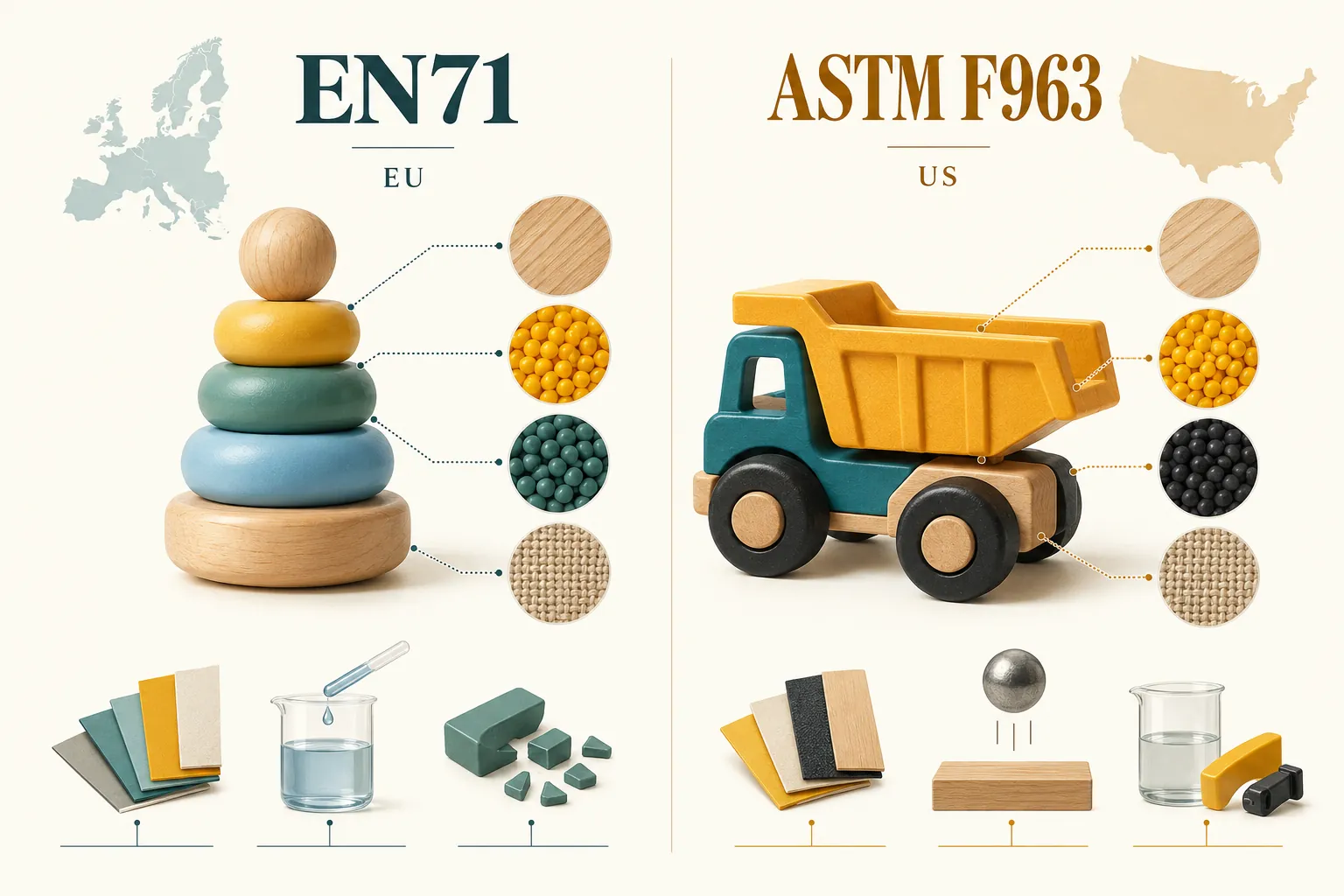
Approve a proposed toy material change only when evidence connects the changed part to the order’s agreed specification, intended use, and destination-market review. For a gesture-controlled stunt car with music, lights, and spray, compare the replacement material against both the specified construction and relevant functions—not merely its appearance. A Shantou toy manufacturer’s substitution proposal should lead to one recorded outcome: approval, rejection, or conditional approval with explicit limits on production and shipment.
Treat each affected assortment item separately unless a documented technical rationale supports shared evidence. Approval of one car’s replacement part is not blanket approval for other models, colors, or constructions.
What counts as a material change for a Shantou toy assortment item?
Use “material change” as a purchasing classification for a change that could affect agreed construction, function, safety assessment, labeling, or delivery condition; it is not limited to replacing a physical material.
The following classifications are recommended buyer controls, not a toy-specific legal reporting scheme. An administrative change earns the lighter review only after its limited scope is established.
| Resin, colorant, coating, adhesive, or material-source substitution | Route for technical review. Identify the affected part and formulation, compare them with the approved baseline, and assess the implications for performance and relevant safety evidence. The same generic material name does not establish equivalence. |
|---|---|
| Mechanism or component alteration | Review changes to drive components, controls, lights, sound, or a spray assembly against the functions and construction actually affected. A material declaration alone cannot demonstrate unchanged operation. |
| Packaging protection or warning change | Review a different protective insert, retention method, warning, or instruction for its specific consequences. Keep packaging protection checks separate from the assessment of warning content. |
| Different age positioning or destination market | Open a scope review even if the physical toy is unchanged. Confirm the intended user, use conditions, labeling, and applicable destination requirements before extending an earlier approval. |
| Catalog-number correction or cosmetic artwork edit only | Use administrative review when the old-to-new identity mapping is clear and there is no change to construction, warnings, instructions, product claims, or protective packaging. Retain the redline and a scoped no-technical-change declaration. |
What evidence should the buyer request for a proposed material change?
Request evidence that explains the specific substitution and its consequences, rather than a general factory document pack.
Start with a marked-up specification or bill of materials identifying the affected part, old and proposed material identifiers, supplier or formulation changes where relevant, and proposed revision. Attach a material declaration or technical data sheet linked to that part. Ask the manufacturer to state what remains unchanged, including adjacent components and processing where these could affect the assessment.
Use a representative revised sample to examine the consequences that documents cannot show. Label it with the model, revision, material variant, and sample date. For a moving RC toy, agree checks relevant to the changed part—such as fit, retention, clearance during operation, or interaction with the spray assembly. Record the agreed target separately from the observation. These are purchasing checks, not substitutes for applicable safety testing.
Have the responsible technical or compliance reviewer determine whether existing reports cover the changed construction and intended destination, or whether additional assessment or testing is needed. Review sample identification, photographs, tested materials, scope, and applicable requirements. Neither a report’s date alone nor an internal model-number change automatically settles coverage.
Where packaging changes, request both redlined and clean artwork plus the revised packing specification. Confirm the revised-sample path, current quote, age evidence, destination documents, and any effect on the agreed delivery window before committing the changed version.
Which specification and revision should control the comparison?
Compare the proposal with the specification and approved sample governing the affected purchase order, not with a similar catalog listing or the supplier’s latest general description.
Record the baseline revision and proposed revision as separate identities. Keep the original requirement intact: a supplier’s observation that a replacement part “fits” must not silently replace the buyer’s specified material or agreed acceptance criterion.
For an assortment, identify which models, variants, quantities, and production lots the proposal covers. Shared evidence can support more than one item when the reviewer documents why the affected construction and assessment are representative. Unaffected items can remain outside the change hold when their separation is established.
Separate three questions in the record: What was specified? What does the submitted evidence actually show? What remains necessary for a decision? A declaration, sample observation, and laboratory result answer different questions; none should be relabeled as another.
How would the worksheet handle a stunt-car material substitution?
A proposed housing-resin substitution should remain outside production approval until the buyer can assess it against the controlled baseline and relevant evidence.
The catalog example is a 1:16, 2.4 GHz, six-wheel 4WD gesture-controlled stunt RC car with music, lights, and spray. Its October 9, 2026 catalog record lists plastic, single-item packing, and a reference MOQ of 48. Specify the material by affected component: the broad catalog label does not define a housing formulation. Reconfirm the current commercial terms for the revised construction.
The worksheet below is a hypothetical review, not an actual supplier proposal or test result. Revision A, proposed Revision B, and the housing substitution are illustrative. The scenario assumes that a substitution request has been received but supporting technical evidence has not yet been submitted.
| Change identity and order scope | Illustrative request: substitute the housing resin on the gesture-controlled six-wheel stunt car. Link the request to the affected purchase-order line and variant schedule; limit the review to those identified items. |
|---|---|
| Baseline and proposed revision | Illustrative Revision A: retain the buyer-approved housing material and construction. Proposed Revision B: use an alternative housing resin. Preserve Revision A and its approved sample as the comparison baseline. |
| Classification and reason | Technical material change. The proposal changes a physical component material; an unchanged appearance would not establish unchanged properties or report coverage. |
| Specified target versus observed evidence | Target: meet the controlled material specification and agreed requirements for the affected housing. Observation in this scenario: the request describes a substitution, but no revised-sample observations or supporting test results have been submitted. |
| Evidence requested | Part-level specification redline; old and proposed material identifiers and supporting declarations; a scoped statement of unchanged construction; a labeled revised sample; and a technical assessment of relevant existing-report coverage and any additional testing. |
| Function and packaging comparison | Compare the revised housing with the approved sample for agreed fit, retention, and operating clearances. Confirm whether the spray assembly or protective packing is affected. Record actual observations against the agreed criteria rather than entering an assumed pass. |
| Age and destination review | Confirm the intended age positioning and order destination. Assign a technical or compliance reviewer to determine which construction, labeling, and test-document implications follow from the substitution. |
| Decision | Illustrative decision: reject production release of proposed Revision B as submitted; permit evaluation sampling only. This is a rejection of the release request, not a finding that the replacement material is unsafe. |
| Responsible approver and decision date | Scenario decision owner: the buyer’s authorized procurement approver, supported by the designated technical reviewer. Illustrative review date: October 27, 2026. In a live record, enter each responsible person’s full name and attributable approval. |
| Follow-up owner and release restriction | Assign the manufacturer’s change contact to submit the evidence package and the buyer’s technical reviewer to assess it. Do not substitute Revision B into the order under this decision. Any production of Revision A remains subject to its existing order authorization. |
| Closure and re-review | Keep the Revision B production-release restriction open. Re-review the linked evidence and revised sample, record each acceptance or rejection, then issue a new dated decision defining the approved revision and order scope. Evidence submission alone does not close the restriction. |
Who approves the change, and when can the order be released?
The buyer or its authorized agent makes the purchasing decision, supported by a qualified technical or compliance reviewer for the questions within that reviewer’s remit.
Approve when the evidence satisfies the agreed requirements for the defined revision and order scope. Reject when the proposal conflicts with a nonnegotiable requirement or does not support the requested release. Use conditional approval only when the permitted activity and remaining restrictions are explicit—for example, approval to make evaluation samples while production release remains blocked.
Do not write only “approved subject to testing.” State which assessment is required, who owns it, what evidence closes it, and who authorizes the next release. Include the decision date, approver identity, referenced specification and sample revision, evidence list, affected order lines, and condition status.
Close each condition with the accepted evidence reference, responsible reviewer, and closure date. If the evidence introduces another material or construction change, revise the assessment rather than closing the original condition against a different proposal.
How does the approval record support the delivered assortment?
Link the approved revision to production and shipment identification so receiving checks can compare delivered items with the version the buyer actually authorized.
Request a clear cutover record for the changed version and a way to distinguish it from remaining baseline stock. During inspection, compare identifiable construction and packing details with the approved sample and order specification. Use appropriate technical verification where visual inspection cannot establish material identity.
Keep superseded revisions and decisions linked rather than overwriting them. This creates an attributable explanation of what changed, which evidence supported the decision, and who released it. The record supports traceability; it does not by itself prevent or reveal an undisclosed substitution.
Next step