
TRADE DESK NOTE
EXW vs FOB for Buyers Sourcing Toys from Shantou
EXW vs FOB won't tell you whether a Shantou toy factory can support your market. What to check at the door, on the sample, and in the records you take away.
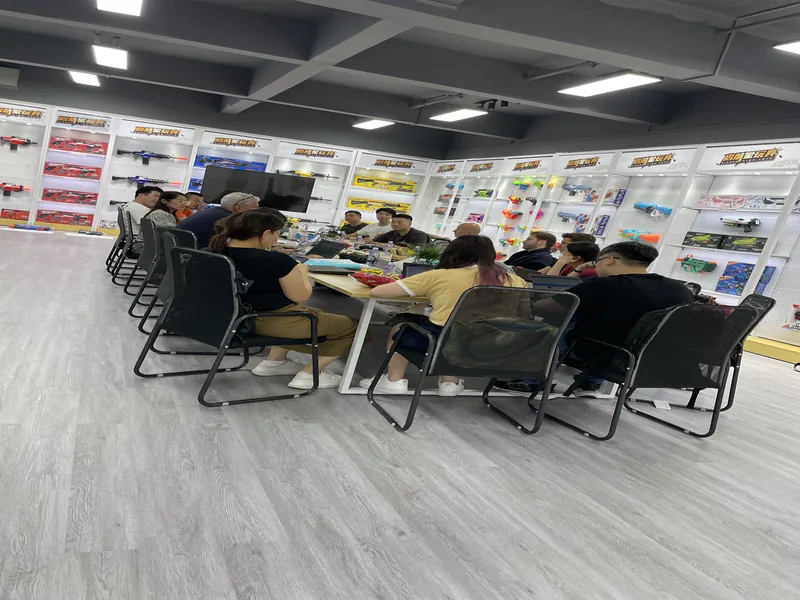
Neither EXW nor FOB tells you whether a Shantou toy factory can actually support your market — both terms only allocate freight and risk, and neither certifies a toy or replaces CE, CPC, UKCA or other market evidence. Choose the term by who controls the goods the day before shipment (EXW puts inspection at the factory gate; FOB puts it at the factory plus loading at the origin port), then spend your real diligence on the documents behind the SKU. This page is a one-day factory-visit checklist: what to ask for at the door, what to open on the sample, and which records to physically carry out with you.
At the door: which documents decide whether the visit continues
Before you walk the line, ask for the legal entity name, the site address on the business licence, and a test report or certificate that names the actual model — if the paperwork cannot be tied to the product you are quoting, stop the visit there and rebook. A supplier relationship is worth nothing if the document trail starts and ends with a category name.
The European Commission is explicit that CE marking is the manufacturer's own declaration of conformity and is not approval by an EU authority — and CE marking does not identify a product's origin. So a CE string or logo in a catalogue proves nothing about who made the toy or whether anyone checked it. Under Directive 2009/48/EC, the manufacturer alone carries out the conformity assessment, importers must ensure third-country toys comply, and distributors must act with due care. If you place the toy under your own name or trademark, or modify it in a way that affects compliance, you are treated as the manufacturer. That is a legal role, not a shipping term.
What to actually request at the door, in this order: the business licence and the name of the legal person signing the contract; the certificate or report with the model number visible on the same page; and the identity of the party that will appear as manufacturer or importer on the toy and its packaging. Under 2009/48/EC importers must indicate their name and contact address on the toy, subject to limited exceptions where size or nature prevents it or it would require opening the packaging. If nobody in the room can tell you whose name goes on the box, the visit has already answered your question.
| Business licence & legal entity | Must match the name on the quotation and contract |
|---|---|
| Test report / certificate | Model or SKU description must match the quoted item |
| CE documentation | Manufacturer's declaration of conformity — not EU authority approval, and not origin evidence |
| Responsible party on the toy | Importer name and contact address required under 2009/48/EC, subject to limited exceptions |
| If any of the above is missing | Do not continue the visit; rebook after the file is complete |
On the sample: the one thing to open, and the one question to ask
Open the sample the way a consumer would — packaging, inserts, detachable parts, battery compartment if there is one — and then ask which rule set and which laboratory scope covers this exact configuration. That single question separates a supplier who owns a compliance file from one who owns a logo.
CPSC guidance states that laboratory acceptance is specific to the relevant safety rules and that one laboratory may not cover every required test. The buyer should match the applicable requirements and the laboratory scope to the actual toy configuration. Treat this as a document-review principle: it does not mean any model has been tested, and no factory should be described as certified because a report exists somewhere in the building.
The same discipline applies to certificates. CPSC guidance says a Children's Product Certificate must describe the covered product sufficiently to match it to that product — a generic category name does not establish coverage of every catalogue SKU. So the question on the sample table is not "do you have a CPC?" It is "show me the CPC whose product description matches this item, with the rule references, and tell me which configuration it covers."
Age grading belongs in the same conversation. Small-part risk has to be assessed against the actual product configuration, and assemblies, detachable accessories and packaging components need the same review. For battery-operated toys, published US recall cases are a useful prompt for what to ask rather than what to assume: recall 26-300 (Children's Christmas Tree Toy Play Sets) combined lead above the federal lead content ban with mechanical and electrical non-compliance for battery-operated toys; recall 26-296 (KiddoSpace Children's Flashcard Talking Toys) cited lead and phthalates above federal bans plus a short-circuit protection failure; recall 26-609 (WonderStone Infant Walkers) turned on doorway fit and step-edge stopping under the mandatory infant walker standard. These are historical official cases with no connection to any particular supplier, and they are not findings about the factory in front of you. They are simply the questions worth asking on the sample table.
The commercial record is worth opening too. A catalogue entry is a snapshot, not a commitment. A scoped catalogue record for a wooden light-up tumbler toy, for example, shows a reference MOQ of 108, single-item packing, 3.0 kg, and a reference price of 3.8 USD — useful as a starting shape for a quote, but it establishes a catalogue record only, not certification, stock or factory capacity. MOQ, packing, units per carton, size, weight and price all have to be reconfirmed against your own specification before you treat them as real.
| What to open on the sample | Packaging, inserts, detachable parts, battery compartment where applicable |
|---|---|
| Question to ask | Which rule set and which laboratory scope covers this exact configuration? |
| Certificate test | Does the product description on the certificate match this item? |
| Age grading | Assess small-part risk against the actual configuration, including accessories and packaging |
| Battery-operated toys | Ask how short-circuit protection and mechanical/electrical requirements are addressed |
| Commercial record | MOQ, packing, carton quantity, size, weight and price — reconfirm all of them |
Before leaving: the records you physically take away
Leave with files, not impressions. Take a photo of the business licence and note the exact legal entity name; take the page of the test report that shows the model number and the standard edition; take the certificate that names the product; and take a written statement of who will be identified as manufacturer or importer on the toy and packaging. If a document does not exist yet, write "unknown" in your notes and put it on the follow-up list — do not let a verbal assurance stand in for a file.
Two documents are commonly missing and both matter for a 2026 order. First, tracking information: CPSC guidance treats tracking labels as permanent product identification, so review packaging, product markings and lot control together — a lot code that only exists on the carton is not the same as one on the product. Second, the electronic certification requirement: CPSC states that beginning July 8, 2026, importers of most regulated consumer products will be required to electronically file certificates. Check the current scope and your own filing obligations against the applicable rule before you plan the shipment, and treat any summary of it as a prompt to read the source, not a substitute.
On the EU side, remember that the Toy Safety Directive is not the only instrument. Regulation (EU) 2023/988 (GPSR) is a separate horizontal product safety framework for consumer products, it applies to distance selling and online sales including offers targeted at EU consumers, and it covers online marketplace providers, accident obligations, consumer information and remedies, and recalls. It does not change because you bought on EXW or FOB. If your route to market includes a marketplace, map who holds which role before the goods leave Shantou.
Write the inspection milestone into the order itself. EXW gives you a natural checkpoint at the factory gate before the truck arrives; FOB adds loading supervision at the origin port. Neither term creates the checkpoint automatically — you do. Fix the sampling plan (AQL 2.5 at General Inspection Level II is a common starting point), the reporting window, and the rule that defects above the agreed limit are corrected before loading, and tie the balance payment to a passed report. A verification step only creates leverage if it happens while you can still change the decision it informs.
| Legal entity record | Photo of business licence + exact name used on the contract |
|---|---|
| Test document | Page showing model/SKU, age grade and standard edition |
| Certificate | Product description matching the quoted item |
| Responsible-party statement | Written confirmation of who appears as manufacturer or importer |
| Tracking label plan | Permanent identification reviewed with packaging and lot control |
| Inspection milestone | Sampling plan, reporting window, correction before loading, balance tied to result |
| Anything unavailable | Record as unknown and put it on the follow-up list |
FAQ
Does choosing EXW or FOB change my legal obligations as an importer?
No. Incoterms allocate trade responsibilities such as freight and risk transfer; they do not certify the toy or replace CE, CPC, UKCA or other market evidence. Under Directive 2009/48/EC, importers must ensure third-country toys comply, that conformity assessment was carried out, and that markings and documentation are available to authorities.
If the factory shows me a CE mark, does that mean the toy is EU-approved?
No. The European Commission distinguishes the manufacturer's CE declaration from approval by an EU authority, and CE marking does not identify a product's origin. Ask instead for the declaration of conformity and the technical documentation behind the specific model you are quoting.
Can one test report cover every product in a factory's catalogue?
No. CPSC guidance says laboratory acceptance is specific to the relevant safety rules and that one laboratory may not cover every required test; the requirements and laboratory scope must match the actual toy configuration. A Children's Product Certificate must also describe the covered product sufficiently to match it to that product — a generic category name does not cover every SKU.
When should I book the factory visit relative to the deposit?
Before the bulk order starts, not after. A verification step only creates leverage if it happens while you can still change the decision it informs — a finding after the tooling is paid and the deposit has left is a discussion, not a decision point.
What sampling plan should I write into a toy order?
AQL 2.5 at General Inspection Level II is a widely used starting point for consumer goods, and it should be paired with a fixed reporting window and a rule that defects above the agreed limit are corrected before loading. Confirm the sampling plan against your own specification rather than assuming a default applies.
Do I need to check anything beyond toy safety for an EU shipment?
Yes. Regulation (EU) 2023/988 (GPSR) is a separate horizontal product safety framework that applies to distance selling and online sales targeted at EU consumers, and it covers online marketplace providers, accident obligations, consumer information and remedies, and recalls. Map which party holds each role before the goods leave Shantou.
Sources
- Audit Before the Bulk Order Starts: Which Stage Catches Which Risk
- EXW, FOB or DDP: How Your Shipping Terms Decide Whether Your China Order Ever Gets Inspected CloudSpects
- FOB条件下货物验收操作指南
- FOB验货:跨境卖家必知的出口质量控制流程
Request a Quote
Send the SKU, destination market, and the documents you already have.
Next step