
TRADE DESK NOTE
How Product Size Changes Carton Planning and Shelf Presentation
How product and pack size drive carton planning, pallet fit, dimensional weight, and shelf presentation — plus the documents to have ready at a customs exam.
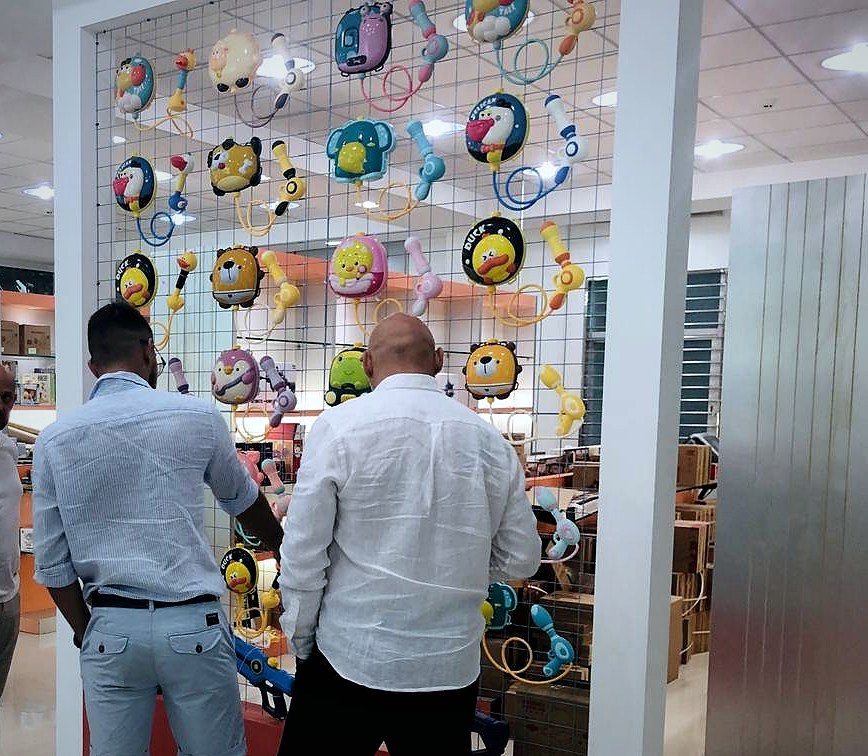
Settle product dimensions and pack format before you approve artwork, carton specs, or a display quote — because size is the input that decides units per carton, master-carton count, pallet configuration, dimensional-weight cost, and how many facings the item earns on shelf. Change the pack and you have changed the barcode, the case configuration, the pallet footprint, and the planogram position all at once.
This page covers the carton-planning and shelf-presentation decisions that follow from size, what paperwork a customs officer actually asks for when a shipment is pulled, and the questions to put to a supplier before you commit. Toy sizes and pack data below come from catalog records, not verified production specs; reconfirm sample, current quote, age evidence, and destination documents before ordering.
What documents does a customs examiner ask for when a shipment is pulled?
| Commercial invoice | Why the officer asks: to check declared value and unit price against the entry. | Where it should be: with the broker and in your own file, matching the PO. | If you do not have it: entry cannot be liquidated; goods sit in a bonded facility at your cost. | |
|---|---|
| Packing list | Why the officer asks: to match carton count, units per carton, and gross weight to the container. | Where it should be: same version as the invoice; carton numbering consistent. | If you do not have it: the examiner opens cartons by hand, which is slower and damages retail packs. | |
| Bill of lading / AWB | Why the officer asks: to confirm the shipment matches the declaration and the carrier record. | Where it should be: with the broker before arrival. | If you do not have it: release is blocked regardless of what else you hold. | |
| Test report or certificate of conformity | Why the officer asks: to see that a children's product was tested against the destination standard. | Where it should be: on file, retrievable, with the report covering the actual item and age grade. | If you do not have it: the shipment can be held pending sampling and laboratory review. | |
| Age grading and warning statements | Why the officer asks: to verify the age claim on pack matches the product and the applicable rule. | Where it should be: printed on the retail pack, not only on the carton. | If you do not have it: the item can be refused entry even when the toy itself is fine. | |
| Product dimensions and net/gross weight record | Why the officer asks: to reconcile weight declared against the physical carton, and to assess duty where weight matters. | Where it should be: in your spec sheet, matching the packing list. | If you do not have it: discrepancies trigger a fuller examination, and you pay the dwell time. |
Worked example (illustrative, not a real shipment)
A buyer books roughly 4,000 units of a small plastic travel game across two destinations — a US 3PL and a European retail DC. The supplier quotes the same retail pack for both, but the buyer asks for two master-carton configurations: a denser case for the DC, which receives full pallets, and a smaller case for the 3PL, which picks eaches.
Two things go wrong at once. First, the denser case pushes the pallet over the height limit the DC's racking allows, so the load is re-palletized on arrival — a charge that never appeared in the quote. Second, the carton dimensions recorded in the catalog snapshot no longer match what was packed, because the pack count changed after the spec freeze. The customs examiner pulls the shipment because the declared gross weight and the physical carton disagree.
The step that costs money is not the exam itself; it is that nobody recalculated carton CBM and the packing list after the pack quantity changed. Carton CBM is derived from measured outer-carton dimensions and has to be recalculated whenever carton size or pack quantity moves. Freeze product dimensions, pack format, and units per carton together, then issue one packing list both destinations can be reconciled against.
Which carton data do you need before you approve a quote?
You need six numbers per SKU before a quote is meaningful: product height, width, and depth; gross weight; units per retail pack; and units per master carton. Everything downstream — case cube, container fill, pallet pattern — is arithmetic on top of those.
The catalog records show why this matters. One building-block set carries a recorded size of 28×10×22 cm at 2.0 kg with 48 units per carton; a travel board game is recorded at 19×9×28 cm, 4.0 kg, 96 units per carton; a DIY miniature house sits at 27×7×20 cm, 2.6 kg, 48 per carton. Similar-looking footprints, very different carton math. Several other records list units per carton as None or source size as None — those SKUs cannot be planned for carton fill at all until the supplier supplies measured data.
Ask the supplier: "What are the confirmed units per carton and measured outer-carton dimensions for this SKU, and do they match the catalog record?" Then ask for the carton's measured dimensions in writing, not the retail pack size.
Why does pack size change the barcode, the pallet, and the planogram together?
A pack-size change is an operational event, not a marketing tweak. It forces a new barcode, a new listing, and a planogram update that a category buyer has to sign off. A carton that held 24 units of one size may hold 30 of a smaller one, which shifts the pallet configuration and the case cube along with it.
That is the shrinkflation mechanic seen in grocery: keep the shelf price steady, reduce the contents, and refresh the graphics. It is a quiet cost-management lever rather than a strategy, and shoppers who catch it twice in two years remember it. For a toy range, the steadier route is a genuine tier — a small trial format, a standard format that stays consistent for years, and a larger value format — rather than one pack that quietly shrinks under freight and material pressure.
Ask the supplier: "If we reduce the pack count, what changes in the barcode, the case configuration, and the pallet footprint — and can you quote both configurations side by side?"
How does size decide whether an item gets shelf space or a bottom shelf?
Size sets facings before it sets anything else. Larger packs read like billboards but cut the number of facings; smaller packs fit more units and often land better placement. Retailers are running the arithmetic on sales per square foot and restocking speed, so a pack that is awkward to replenish loses space regardless of how good it looks.
Height has a hard ceiling. Products taller than the typical 12–18 inch eye-level band may end up on lower shelves, and that range is not a universal standard across retailers or categories — confirm it with the account. Smaller packs are also frequently rated more favorably than larger ones from the same brand when viewed in isolation, which is why trial and impulse sizes hold their own at the checkout.
Ask the supplier: "What is the shelf-ready pack footprint, and does the retail pack stand, hang, or need a tray?" If the item needs dividers, front lips, or reinforced shelves to merchandise properly, that is a carton and display cost, not a design detail.
Where dimensional weight quietly eats the saving from a tighter pack
Carriers including UPS, FedEx, and USPS price on dimensional weight, so an oversized carton costs more even when the toy inside is light. A smaller retail pack that ships in an unchanged master carton saves nothing. Right-sizing the case is where the money is — and the effect is real enough that right-sized packaging has been linked to double-digit improvements in bottom-line savings, with better shelf density supporting top-line growth.
The practical test is simple: divide carton CBM by units per carton and compare configurations on cost per unit shipped, not on cost per carton. Then confirm the pallet footprint against the destination retailer, region, and logistics requirement rather than assuming a default — US pallets commonly run 48×40 inches, while many European and international logistics situations use 1200×800 mm or 1200×1000 mm.
What changes in 2026 that touches size and packing decisions?
Tariff exposure is the live variable for US-bound toy shipments in 2026, and it is a risk rather than a settled number — the legal basis has been contested in 2026, so treat any rate as provisional and ask your broker for the current position on your HTS lines. Some factories have responded with split minimums and sub-component localization; that changes nothing about your carton math, but it can change where a case is packed and how the packing list reads.
On standards, Hong Kong has updated its requirements for toys and children's products, with compliance assessed against the safety standards specified in the Toys and Children's Products Safety Ordinance schedules. If your destination is Hong Kong or your goods transship there, confirm which schedule your category falls under. Where an official text does not confirm an applicability date for a market, write the timeline as not confirmed from official text rather than assuming a mandatory date.
Digital Product Passport, GPSR, and toy safety rules are separate regimes. Do not merge them into one deadline. Confirm each one against the destination and the product category.
FAQ
Should I lock the retail pack size before or after I choose the carton?
Lock them together, in one spec freeze. Product dimensions, units per retail pack, and units per master carton are one decision; changing the pack count afterwards invalidates carton CBM, the packing list, and the pallet pattern. Issue one frozen spec sheet to the supplier and the broker.
Does a smaller retail pack always mean lower freight cost?
No. Carriers including UPS, FedEx, and USPS price on dimensional weight, so an unchanged master carton costs the same no matter how small the retail pack inside is. The saving only appears when you resize the case and compare cost per unit shipped.
How many units per carton should I ask for?
There is no standard. The catalog records in this snapshot alone run from 48 to 96 units per carton, and several SKUs list no carton quantity at all. Ask for the measured outer-carton dimensions and units per carton for the specific SKU, then test the configuration against your pallet and your picking model.
What do I hand over if a shipment is pulled for examination?
The commercial invoice, packing list, bill of lading or AWB, the test report or certificate of conformity covering the actual item and age grade, and age grading with warning statements printed on the retail pack. If the declared weight and the physical carton disagree, expect a fuller examination and dwell time at your cost.
Can I use one carton configuration for a 3PL and a retail DC?
Usually not well. A DC that receives full pallets wants a dense case; a 3PL picking eaches wants a smaller one. Ask the supplier to quote both configurations so you can compare cost per unit shipped rather than cost per carton, and confirm the pallet footprint against each destination.
Do the sizes and MOQs in a catalog snapshot count as confirmed specs?
No. Catalog records establish a record only — not certification, infant suitability, licensing, stock, or factory capacity. Reconfirm sample, current quote, age evidence, and destination documents before you commit to a purchase order.
Sources
Before you send the PO
Pull your spec sheet and check three boxes: product dimensions and gross weight confirmed in writing, units per carton and measured carton dimensions matching the packing list, and the destination documents for the age grade on file and retrievable. If any one is missing, that is the step where a shipment gets held. Send your RFQ with the target market, age grade, and required carton configuration stated up front — suppliers quote faster and more accurately when the size decision is already made.
Next step