
TRADE DESK NOTE
Shantou Private-Label Toys: How to Set Labeling Handoffs
Define per-SKU labeling, sample and artwork references, approval owners, and change closure for Shantou private-label toy assortments.
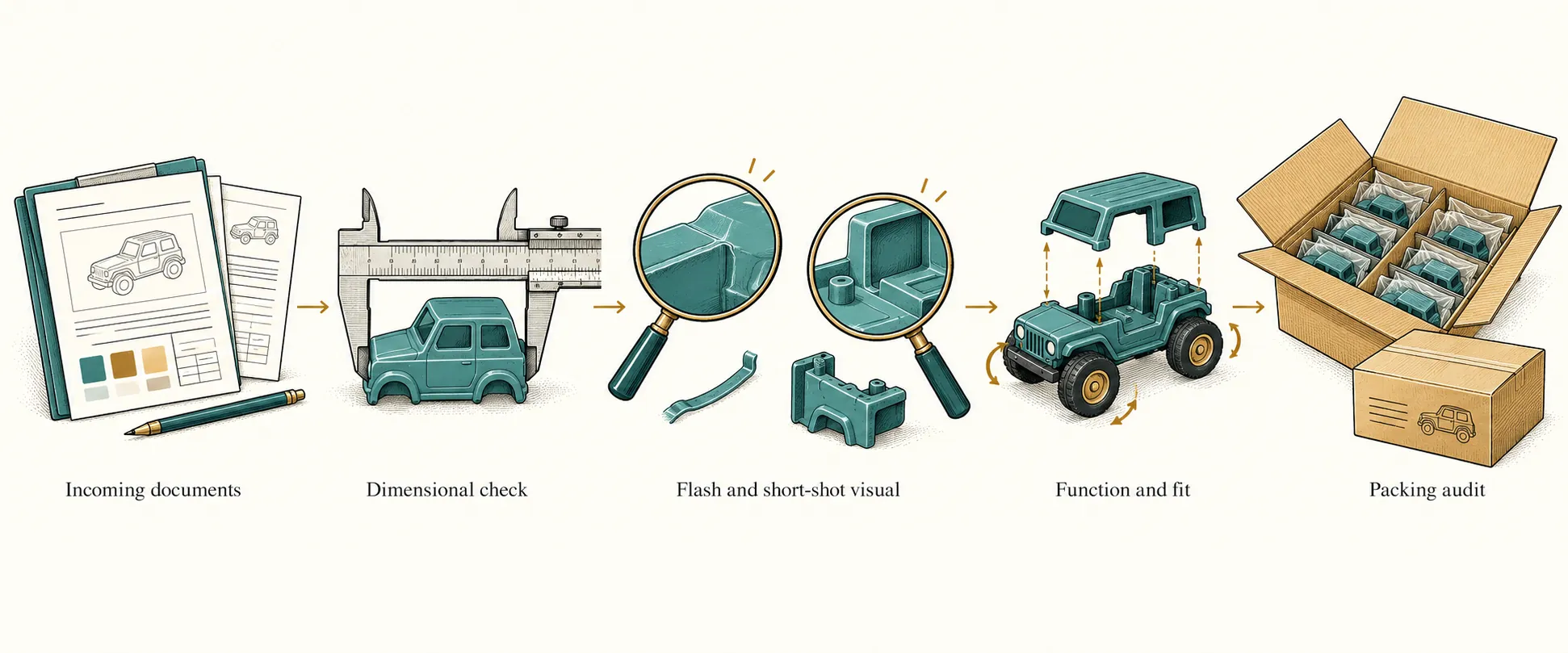
For a Shantou assortment combining adjustable-speed mini RC cars and gesture-controlled stunt cars, approve a separate labeling record for each SKU and destination before releasing print files. Your private-label toy supplier in China should receive exact label content, placement drawings, an approved sample reference, artwork revision, named approvers, and a change-closure record. Share the brand layout across the assortment, but keep functional claims, instructions, age decisions, and market-specific text tied to the individual product—not to a generic “RC car” box.
Treat the handoff as a production instruction with a release decision, not an email attachment called “final artwork.” It should tell the factory what to print, where to apply it, which physical configuration it belongs to, and who can authorize a change.
Which Labeling Decisions Can These Two RC Cars Share?
| Adjustable-speed mini off-road RC car | Recorded features: 2.4 GHz remote control and adjustable speed. Recorded material: plastic. Packing: single item. Reference MOQ: 288 units. Labeling application: verify the speed-control description, supplied controls, and operating instructions against the selected sample. |
|---|---|
| 1:16 gesture-sensor stunt RC car | Recorded features: 2.4 GHz remote control, six-wheel 4WD, gesture sensing, music, lights, and spray. Recorded material: plastic. Packing: single item. Reference MOQ: 48 units. Labeling application: verify which controls and features are supplied, then approve matching illustrations and instructions. |
| Shared assortment artwork | A proposed shared master can carry the brand logo, typography, and panel structure. Each product still needs its own approved identity, images, contents statement, feature copy, instructions, and destination version. |
What Must Be Fixed Before Artwork Approval?
Fix the product configuration, destination, age decision, and packaging format before approving the labeling content.
For these RC cars, inspect the selected vehicle and every supplied control or accessory. Confirm the battery and charging arrangement, package contents, and operating sequence before writing instructions. A catalog material entry of “plastic” is not a complete construction specification; it should not become an unsupported claim about every component.
Establish the intended age grade through the responsible product review rather than copying an age icon from another car's box. Age grading is a product-development input, not merely a marketing choice. Toy Development Guide
Name the destination country and required language versions. Have the designated market reviewer approve the applicable warnings, business identities, addresses, identification details, and marks for that product. Treat these as review fields—not as a universal list of legal requirements for every toy or destination.
What Should the Per-SKU Labeling Handoff Worksheet Contain?
| Record identity and revision | Enter handoff ID, revision, issue date, order or assortment reference, buyer item number, supplier model identifier, destination, and language version. Identify the previous revision being replaced. |
|---|---|
| Product and sample reference | Enter the product description, selected features, supplied controls and accessories, approved sample ID, sample date, and linked photographs. Record any difference between the sample and the intended production configuration. |
| Packaging configuration | Specify the agreed retail-pack format, contents, inserts, label-bearing surfaces, and carton-marking scope. Keep retail-pack artwork distinct from outer-carton artwork. |
| Product identity and claims | Provide exact product name, model text, images, feature statements, and contents list. Reference the sample or other supporting record for each functional claim. |
| Age grade, warnings, and instructions | Enter the approved age statement, exact warning text, operating instructions, and language versions. Name the reviewer and supporting assessment or document revision. |
| Business identities and addresses | Record the approved manufacturer, private-labeler, importer, or other responsible-business details selected through destination review. Specify the exact spelling, address, role, and label location. |
| Production and traceability information | Specify production-location information, production-date format, batch or cohort code, and the record used to decode it where included in the approved specification. Define who generates variable data and who checks the first production example. |
| Placement and print specification | Reference an annotated drawing showing each label location, dimensions, orientation, attachment method, and print specification. Identify which information appears on the toy, packaging, or insert. |
| Artwork and supporting documents | List exact artwork filenames and revisions, instruction-file revisions, placement-drawing revision, and relevant destination-review or report references. Distinguish editable working files from released production files. |
| Target versus observation | For every reviewed proof or sample, record the specified text, position, code, or feature and what was actually observed. Attach photographs or marked proofs and assign each discrepancy an exception ID. |
| Sample path and release dates | Record digital-proof review, printed assembled-pack review, planned print release, and production-release dates. Work backward from the agreed delivery window; identify who must decide if an unresolved label issue affects the schedule. |
| Decision and signatures | Record approved, approved for a named limited stage, or hold. State conditions, buyer or brand-owner approver, market-content reviewer, factory implementation contact, signatures or traceable electronic approvals, and dates. |
| Follow-up closure | List each outstanding condition, owner, due date, corrective evidence, closure reviewer, and closure date. Reference the final released revision and the person authorizing the next production stage. |
Who Approves the Handoff, and Against Which Sample?
The buyer or brand owner should approve the content, the designated market reviewer should approve destination-specific decisions, and the factory contact should confirm implementation against the identified sample and artwork revision.
Review the digital proof for wording, translations, images, and file identity. Then review a printed, assembled pack with the selected physical toy and supplied accessories. Check that instructions describe the actual controls, labels occupy the agreed locations, and packaging folds or seals do not obscure the approved text. These are commercial verification checks, not substitutes for safety testing.
Keep supporting reports attached to the configuration they cover. Compare model, materials, dimensions, components, age grade, and destination scope before treating a report as relevant to the selected product; a narrow material report is not evidence for every part of the assembled toy. Toy Development Guide
Release by stage. Approval of a digital layout can authorize a printed mock-up without authorizing bulk printing. Once the required conditions are closed, issue a release naming the exact artwork revision, sample reference, authorized stage, approver, and date. A signed worksheet supports traceability; it does not by itself reveal an undisclosed substitution.
How Should a Shared RC-Car Artwork Error Be Resolved?
If shared artwork carries a feature that has not been confirmed for one car, hold that SKU's affected artwork and correct its product-specific content rather than approving the whole assortment together.
For example, suppose a shared RC-car proof includes “gesture control, music, lights, and spray” on both versions. Those features are recorded for the stunt car, not for the adjustable-speed mini car. Do not transfer the claim merely because the two products share a category. Compare the mini-car sample with its intended specification, remove or revise unsupported wording and illustrations, and check the corresponding instructions.
Log the target as “feature copy matches the selected mini-car configuration” and the observation as the exact wording found on the proof. Assign the artwork correction to a named owner, obtain a revised proof, and close the exception only after the reviewer records the corrected revision and date. The stunt-car version can proceed separately once its own content and release conditions are approved.
How Are Late Changes and Open Conditions Closed?
| Change identity | Record change ID, request date, affected SKU and destination, requester, current revision, and proposed revision. |
|---|---|
| Before, after, and reason | Quote the original and replacement text or identify the changed image, placement, code format, or product configuration. Explain why the change is requested. |
| Impact decision | Name the reviewer and record affected artwork, instructions, samples, and supporting documents. State whether further assessment, testing review, or reapproval is needed and why. |
| Work already released | Identify affected files, printed packaging, labels, and production stages. Record the agreed action for earlier versions and who verifies its completion. |
| Approval and closure | Enter the decision and conditions, responsible approver and date, corrected proof or sample reference, closure evidence, closure owner and date, and authorized production stage. |
Next step