
TRADE DESK NOTE
Shantou Toy Assortment Samples: Approve, Hold or Reject
Review Shantou toy assortment samples against agreed specifications, record open questions by item, and decide what to approve, hold or reject.
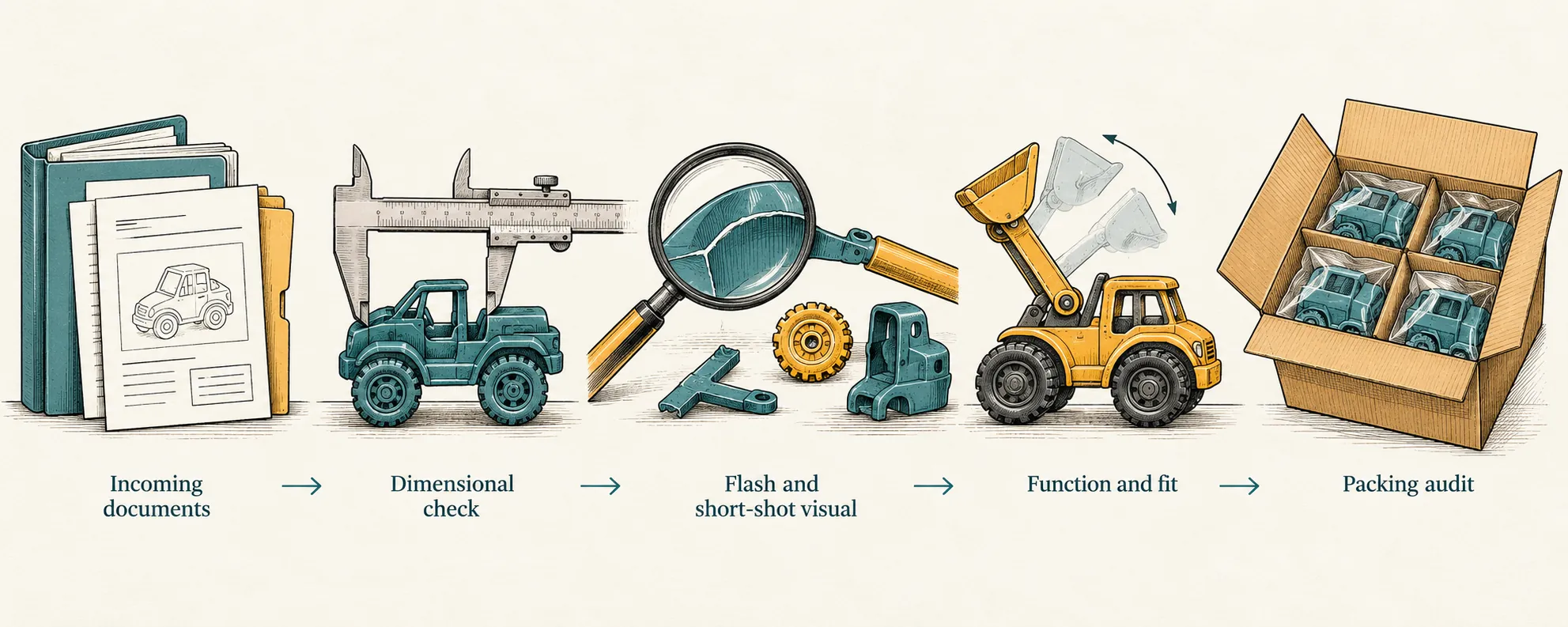
Approve each Shantou toy assortment sample only after comparing its mechanism, materials, finish, dimensions and packaging with the agreed written specification. When reviewing samples from a Shantou toy manufacturer, mark unresolved items hold rather than treating silence as acceptance. A sensory rattle needs a different functional check from a moving pirate-ship building set, but both need an identifiable sample, a recorded decision and a clear next action. Create the retained production reference only after first-sample approval.
Review each item separately. An acceptable sample in one product family does not settle unanswered questions about another item in the assortment.
What can the catalog establish before sample inspection?
A catalog establishes the listed product description and reference ordering fields; it does not establish that a submitted sample meets your requirements. Use those fields to draft the specification, then obtain agreement on the exact version to be sampled.
These examples use catalog references dated October 9, 2026. The product descriptions are starting points for inspection, not confirmation of age suitability, safety testing, current inventory or a current quotation.
| Four-in-one sensory chew-and-rattle set | Listed as a baby sensory product, with TPR recorded as the material and single-item packing. Reference MOQ: 480 units; recorded carton quantity: 96 units. Define the supplied components, intended functions, component materials and packaging before requesting the approval sample. |
|---|---|
| Pirate-ship building set with swing-boat theme | Listed as a 1922+ piece plastic model kit, with a motor mentioned in the product description and color-box packing. Reference MOQ: 18 units. Agree on the exact parts list, instructions, assembled configuration and whether a powered movement mechanism is included. |
What should you inspect before first-sample approval?
Inspect the physical sample against the agreed specification and design revision, not against an unapproved sample or the catalog title alone. Record the sample identifier, receipt date and specification revision before opening the pack.
For a mixed assortment, write a short inspection sequence for each mechanism. The checks below are purchasing checks; visual examination and hand operation do not establish regulatory safety or determine an appropriate age.
| Function and completeness | Compare with the agreed component list, instructions and required functions. For the sensory set, identify every supplied piece and operate each agreed rattle or moving feature. For the ship, reconcile the parts list, assemble the model and operate the agreed movement mechanism. Missing components, assembly that cannot be completed, or a specified function that does not operate trigger a hold for explanation or correction. |
|---|---|
| Materials and construction | Compare the agreed component-level material specification with the supplier's material declaration and the sample's identifiable construction. Record visible differences in parts, joints or surfaces. A TPR or plastic catalog field does not identify every component, and touch alone cannot verify polymer composition. Resolve a material discrepancy through records and appropriate testing where needed. |
| Finish and workmanship | Inspect accessible surfaces, seams, molded edges, print, decoration and assembly joints against the agreed finish requirements. Record cracks, flash, peeling print, uneven assembly or other visible deviations by location. Hold affected items for disposition; do not convert an informal handling check into a safety-test result. |
| Dimensions and fit | Measure the dimensions named in the agreed drawing, using its measurement points, units and buyer-agreed tolerances. Check mating parts and the assembled configuration where relevant. A measurement outside an agreed limit requires correction or an explicitly approved specification change. Confirm whether a listed dimension describes the toy, retail package or another configuration before comparing it. |
| Agreed packaging | Compare the submitted pack with the agreed packaging specification and artwork revision. Check the included items, instructions, product identity, language, print legibility and pack fit. Single-item packing does not establish a particular retail presentation; color-box packing does not establish approved artwork. Hold discrepancies against the agreed pack. |
| Use scene and age-related questions | Compare the proposed use scene and age marking with the buyer's brief and the item-specific assessment and documentation. Do not accept an infant-oriented catalog name as proof of infant suitability. Refer safety and age-assessment questions to the responsible specialist and applicable laboratory evaluation rather than resolving them by hand inspection. |
How do you turn a functional mismatch into a checkable decision?
Record the required function, the observed behavior and the disposition separately so the supplier can address the actual discrepancy.
For the pirate-ship set, a useful proposed acceptance criterion is: the model assembles from the supplied parts using the agreed instructions, and the specified swing mechanism moves without catching during normal operation. If powered movement is part of the agreed configuration, include its operation under the specified setup. These are proposed buyer criteria, not compliance tests.
Suppose a submitted model assembles correctly but its swing catches on a neighboring part. Record which parts contact, the assembly step and the operating condition; attach a photograph or video if useful. Mark the item hold while the supplier identifies whether the cause is assembly guidance, a component mismatch or a design issue. Review the corrected sample against the same requirement before changing the decision.
A missing photograph alone does not invalidate an otherwise identifiable written observation. Equally, a smooth demonstration video does not establish material composition or regulatory safety.
What should a completed per-item review worksheet contain?
Each worksheet row should connect the item and revision to its target requirements, recorded observations, decision, responsible approver and closure action.
The two completed example rows below model a pre-submission desk review, not findings from received samples. Both are held at the sample-request stage until their inspection targets are agreed. The dates are proposed buyer actions, not supplier delivery commitments. In your working file, pair each product name with its supplier item identifier and sample identifier.
| Four-in-one sensory chew-and-rattle set — example desk-review row | Mechanism/use scene: sensory handling and the specifically agreed rattle functions; intended user and age marking to be resolved before approval. Recorded fields: TPR; single-item packing; reference MOQ 480; 96 units/carton. Identity/revision: sensory-set sample request, revision A. Sample status: pre-submission scope review. Target: signed component list, component materials, required functions, dimensions and packaging artwork. Observation: the catalog identifies a four-in-one sensory product, TPR and single-item packing. Decision: HOLD at sample-request stage. Reason/open questions: define the four-in-one contents, component materials, proposed age basis, current quote, sample path, delivery window and destination-specific document scope. Responsible approver: buyer sample-review lead. Example review date: October 27, 2026. Next action: send the consolidated request on October 28, 2026. Closure condition: log supplier answers, approve the sampling specification, then receive and inspect the identified sample. |
|---|---|
| Pirate-ship building set — example desk-review row | Mechanism/use scene: model assembly and the agreed swing-boat movement. Recorded fields: plastic; color-box packing; reference MOQ 18. Identity/revision: pirate-ship sample request, revision A. Sample status: pre-submission scope review. Target: signed parts list and count, instruction revision, assembled dimensions, movement configuration and packaging artwork. Observation: the catalog describes 1922+ pieces, a swing-boat theme and a motor, with plastic material and color-box packing. Decision: HOLD at sample-request stage. Reason/open questions: confirm the exact supplied parts, whether the motor is included, its operating setup, the age-assessment basis, current quote, sample path, delivery window and destination-specific document scope. Responsible approver: buyer sample-review lead. Example review date: October 27, 2026. Next action: send the consolidated request on October 28, 2026. Closure condition: agree the configuration and specification, then inspect assembly, movement, finish, dimensions and packaging. |
When should you approve, hold or reject a sample?
Approve a sample when it matches the agreed requirements and no unresolved condition blocks the specific next stage; hold it when a defined question or correctable discrepancy remains; reject it when the reviewed version cannot meet the agreed requirements or the supplier declines the necessary correction.
Keep sample acceptance separate from order release. A sample may pass its physical review while the purchase remains on hold for a current quotation or item-specific document review. Name the approval scope explicitly: approval to submit a revised sample is not approval for bulk production.
Use hold for an unresolved material declaration, an unconfirmed movement configuration or a packaging deviation awaiting correction. Use reject when, for example, the offered configuration cannot deliver the required function and no acceptable revision is proposed.
An unanswered question is not proof of a defect, dishonesty or a safety failure. Do not treat it as permission to proceed, either. If a supplier cannot resolve a consequential condition by your purchasing deadline, remove that item from the release, request an alternative or reject the current proposal.
Which follow-up questions should you send together?
Send one consolidated follow-up organized by item, with each question tied to a decision-blocking requirement and a requested answer format.
For the sensory set: “Confirm the exact supplied pieces and each function; identify the material of each component; return the proposed dimensions and packaging specification; and provide the basis for the proposed age marking.”
For the pirate ship: “Return the exact parts list and instruction revision; confirm the included movement and motor configuration; identify the operating setup; and confirm assembled dimensions and packaging artwork.”
For both items, request the current sample arrangements, quotation and proposed delivery window in the same correspondence. Keep destination-specific document requests in separate US, EU or other market sections. Ask the responsible reviewer to check that reports and supporting documents cover the proposed construction and intended market; do not infer coverage from a matching product name alone.
Record the supplier's response date and document revisions against the original open questions. A reply closes a question only when it addresses the requirement; a corrected physical feature normally needs reinspection.
What happens after approval and before bulk inspection?
After first-sample approval, identify and retain the approved production reference together with the signed specification, decision record and controlled change history.
Record who approved it, the approval date, its sample identifier, the applicable revisions and any limits on the approval. For every discrepancy, retain the original finding, agreed correction, revised sample or document reference, recheck result and closure signature or equivalent authorization.
Bulk inspection is the next stage. Compare production with the agreed specification, approved reference, packaging requirements and authorized changes together. The retained sample complements those records; it is not the only valid basis for inspection and cannot, by itself, reveal every undisclosed material or process change.
The review is complete when every assortment item has an approve, hold or reject decision, a recorded reason and either a closed condition or a dated next action assigned to a responsible person. Release only the items and stages actually authorized.
Next step