
TRADE DESK NOTE
Misco MT2287 Light-Up Rackets: How to Review Samples
Use the Misco MT2287 recall mechanism to review comparable racket samples, separate observations from testing, and record advance, hold, or reject decisions.
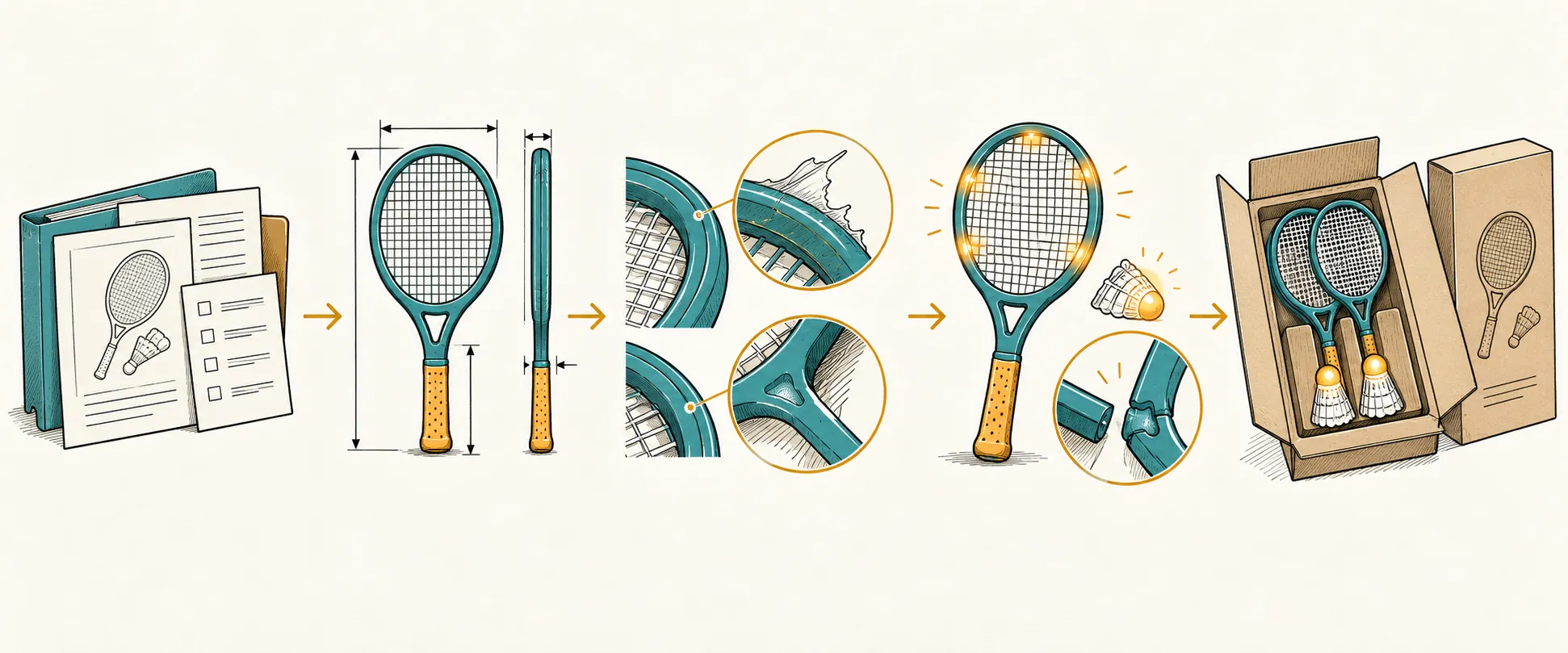
Hold a comparable light-up racket sample when its battery closure or shuttlecock cell access raises an unresolved concern; working lights are not enough to approve it. For a buyer evaluating a Shantou toy manufacturer, the Misco Sports MT2287 recall provides two focused questions: does the racket’s battery-compartment screw remain attached when opened, and how are the shuttlecock’s button cells enclosed? Compare the first sample with the agreed written specification, record discrepancies, and separate purchasing observations from qualified safety testing.
The outcome should be a per-SKU decision: advance to the stated next stage, hold for correction or testing, or reject the submitted construction. This workflow concerns comparable candidate products—not approval of the recalled MT2287 set.
What exactly failed in the Misco MT2287 recall?
CPSC’s May 28, 2026 recall notice, number 26-514, identified two failures in Misco Sports Light-Up Racket Sets, model MT2287: the screw securing the racket’s battery compartment did not remain attached when opened, and children could easily access the button cell batteries in the shuttlecock. CPSC stated that the sets violated the mandatory standard for toys. This is the published finding for that named product, not a conclusion about other light-up racket sets. CPSC recall 26-514
The recalled set contained two black rackets, one ball and one shuttlecock, with “MT2287” and “100125” printed in white on the racket handle. Those details identify the external case; they do not establish a connection to an unrelated Shantou assortment SKU or supplier.
Transfer the questions only where the candidate shares the relevant construction. A similar play scene or an outdoor-sports category label is not a mechanism match.
Does the candidate share the battery-compartment and shuttlecock mechanism?
A full mechanism match requires both a screw-secured racket battery compartment and a button-cell-powered shuttlecock; a partial match transfers only the corresponding review questions.
Identify the power source in every component, including accessories. Record whether each closure uses a screw, snap, slide or another arrangement; for a screw closure, distinguish a retained screw from one that becomes loose during the intended opening procedure. Read accessible cell markings and compare them with the component list and instructions. Do not force open a sealed accessory merely to complete the buyer’s record.
Mark the match as yes, partial or no. If there is no screw-secured compartment and no button-cell shuttlecock, mark these MT2287-specific questions not applicable and assess the candidate’s actual construction instead. That result is not a general safety approval.
What should the first physical sample be compared against?
| Racket closure: does the screw remain attached? | Compare the closure drawing, screw-retention requirement and battery-changing instructions with the sample. Follow the intended opening procedure using the specified tool. Record whether the screw stays retained, the cover seats correctly and the fastener re-engages. A loose screw where retention is specified, a stripped thread or an unseated cover triggers a hold for correction and assessment. |
|---|---|
| Shuttlecock: where are the cells and how are they enclosed? | Compare the power-source specification, component drawing and intended service instructions with the sample. Record accessible cell markings, enclosure location, seams and any visible opening or loose cover. If cells become exposed during ordinary handling, stop the check, secure the sample away from children and hold it for qualified assessment. Do not turn an improvised opening attempt into a safety conclusion. |
| Function: does the light-up behavior match the design? | Operate the controls and activation mechanism as instructed. Record whether illumination starts, stops and remains consistent during the agreed functional check. Flickering, loss of function or a shifting enclosure should be recorded separately from battery-access questions; successful illumination does not close those questions. |
| Materials and finish: does the assembly match the specification? | Compare the agreed material and component descriptions with the sample’s appearance, assembly and supplier documentation. Inspect for visible cracking, burrs, rough edges, loose joints and closure distortion. Record substitutions or defects for correction. Appearance and touch alone do not verify polymer identity, chemical composition or regulatory safety. |
| Dimensions and fit: are the agreed measurements met? | Measure the specified racket dimensions, grip, shuttlecock and relevant enclosure features against the drawing and agreed tolerances. Record target and actual measurements with units. A deviation outside the agreed limit requires a disposition; do not invent a universal tolerance for this product. |
| Packaging and instructions: is the agreed presentation complete? | Compare the set contents, packaging format, model identification, artwork revision and instructions with the written agreement. Record omissions, component-count mismatches and inconsistent battery instructions. Correct commercial discrepancies before approval; refer the adequacy of safety information to the destination-market review. |
Which questions require qualified testing rather than a hand check?
Whether the battery enclosure remains secure under applicable safety-test conditions requires qualified testing; observing a retained screw or working lights does not establish that result.
Ask the laboratory to identify the applicable destination-market requirements, standard edition and prescribed test methods for the candidate’s actual construction and intended age/use. The brief should ask whether the racket closure retains its required performance and whether the shuttlecock’s cells remain inaccessible under those specified conditions. Do not substitute a buyer-devised pliers or pull test.
A functional check also does not establish that mandatory warnings and instructions are complete. Arrange a qualified document review alongside the physical testing. Watchdog Compliance makes this distinction in its retail-check commentary; it is a practical caution, not a statement of legal requirements for every destination. Watchdog Compliance
Keep destination files separate. For a US-bound candidate, request the applicable US test and certification documentation tied to the reviewed construction; maintain a separate assessment for EU-bound or other-market versions. The US recall does not define requirements elsewhere, and a hand inspection cannot determine age suitability.
What belongs in a one-page sample-review record?
| Candidate identity and review basis | Enter the supplier, candidate SKU/model, sample identifier, sample date, design revision, written specification revision and intended age/use. Identify the drawings, component list, instructions and packaging artwork used for comparison. |
|---|---|
| Mechanism match | Record yes, partial or no. Identify each component’s power source, cell type, enclosure and closure type. State which MT2287-derived questions apply and which do not. |
| Specified target versus observation | For each applicable check, enter the agreed requirement, actual observation or measurement, and discrepancy reference. Cover closure retention, shuttlecock cell enclosure, function, materials documentation, finish, dimensions and agreed packaging. |
| Supporting evidence | Reference inspection notes, measurements, drawings, photographs where useful, and relevant reports. Photographs support the record; a missing photograph alone does not invalidate otherwise documented observations. |
| Qualified testing and destination documents | Identify the destination market, report references, tested model/revision and open questions. Request review of report coverage against the actual components and construction, plus the applicable market-specific documentation. |
| Decision and conditions | Choose advance, hold or reject. State exactly what advance authorizes, such as submission for qualified testing rather than production release. List any conditions that remain open. |
| Accountability and dates | Name the responsible buyer or approver, record the decision date, and assign each corrective action or testing question an owner and follow-up date. |
| Follow-up closure and approved reference | Record the correction, replacement sample revision, reinspection or test evidence, closure decision, approver and date. Only after approval, identify and retain the approved production-reference sample and its linked specification. |
When should the buyer advance, hold or reject the sample?
Advance a sample only to a clearly named stage supported by the review; hold unresolved closure or cell-access concerns, and reject a submitted construction that the buyer will not accept.
For example, suppose the written specification requires a retained racket-cover screw, but the screw separates completely during the intended battery-changing procedure. Record “retained screw specified; screw became loose on opening,” identify the sample revision and place it on hold. Ask for a corrected closure and revised construction details. Reinspect the replacement and obtain qualified assessment of the relevant safety questions before closing the hold. This is an illustrative disposition, not a finding about a particular supplier.
If the screw remains retained and the light works, record those observations without writing “battery safety passed.” The candidate may advance to qualified testing while production approval remains on hold. Reject the submitted revision if its construction is unacceptable and no acceptable correction is being pursued; a revised design needs its own documented disposition.
Review supporting reports against the candidate’s model, materials, components and intended age/use rather than accepting visual similarity as coverage. If design, materials or production processes change, reassess whether existing testing still supports the revised product; do not assume every change automatically requires a complete new test program. These are prudent purchasing controls also reflected in Watchdog Compliance’s commentary. Watchdog Compliance
How does sample approval become the basis for bulk inspection?
Bulk inspection should compare production with the approved written specification, retained approved reference, relevant test coverage and authorized change records together.
After approval, label and retain the reference sample with its identity, revision and approval date. In the bulk review, compare the racket closure, screw-retention arrangement, shuttlecock enclosure, light-up function, finish, specified dimensions and packaging with that approved construction.
A retained sample complements the documents; it is not the only valid basis for inspection and does not itself reveal an undisclosed change. When production differs, record the affected units and revision, hold the relevant release decision, and route the discrepancy for correction or assessment. Close it with evidence and an authorized disposition—not merely a replacement photograph.
Sources
Next step