
TRADE DESK NOTE
Spielwarenmesse 2027: Choose US/EU Shantou Toy Documents
Prepare Shantou toy assortments for US/EU review with SKU handoff sheets, document owners, sample gates and a Spielwarenmesse 2027 meeting plan.
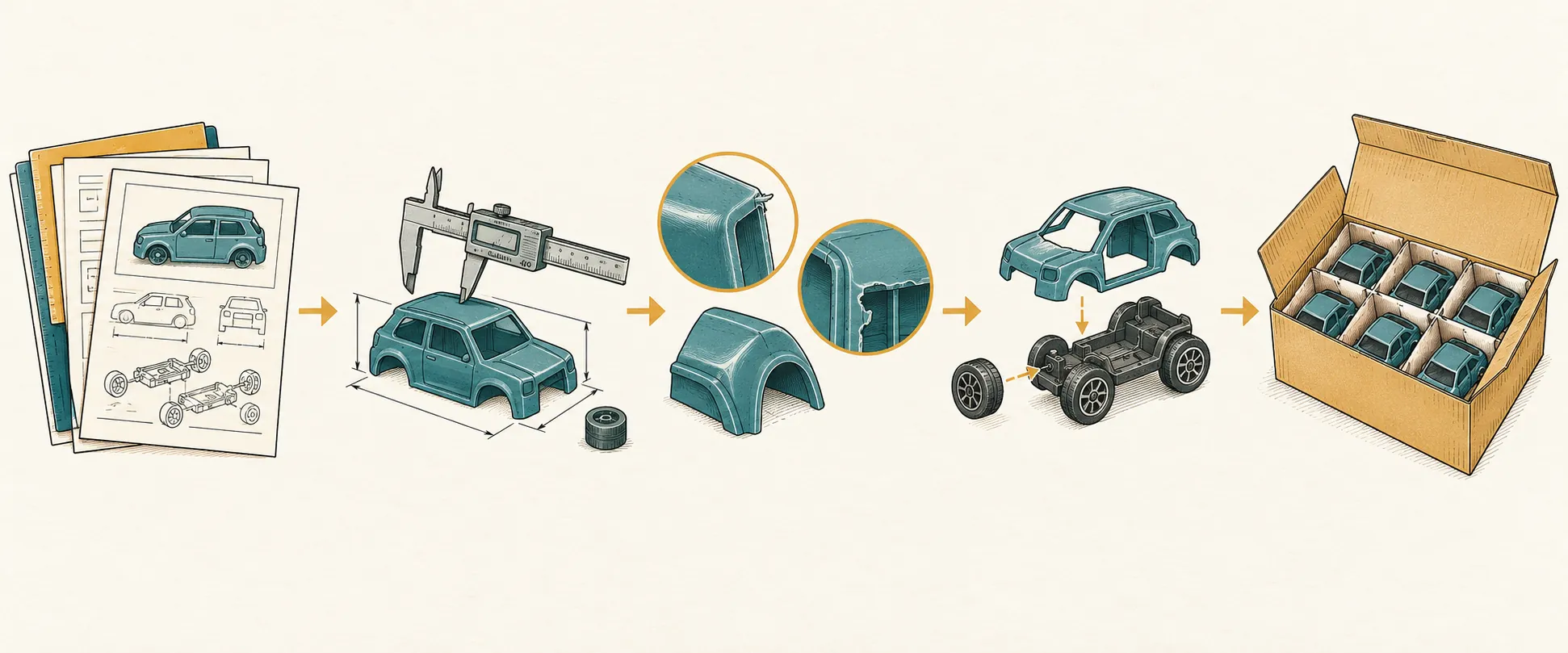
Use a SKU-linked document handoff to choose which Shantou toy assortments advance to samples and supplier meetings, while keeping purchase approval separate. For Spielwarenmesse 2027, ask each Shantou toy manufacturer to connect the product mechanism, proposed age group, MOQ, packaging, sample path and requested delivery window to the intended US or EU destination. Start inquiries while details are being resolved; commit to an order only after the responsible buyer has reviewed the agreed specification, commercial terms and destination-specific document package.
The organizer schedules Spielwarenmesse for February 2–6, 2027, in Nuremberg. Those dates anchor the meeting plan—not production cutoffs, order deadlines or freight lead times. Supplier attendance and appointment acceptance require separate confirmation. Spielwarenmesse planning announcement
Which documents belong before purchase approval?
| Product specification and configuration sheet | Owner: supplier product contact; buyer category manager approves the purchasing target. Useful fields: supplier item reference, buyer item reference, revision, product photographs, mechanism, component list, materials by component, proposed age group, pack contents and included accessories. Mismatch consequence: the sample, quote and technical evidence may describe different configurations; reconcile the difference before approval. |
|---|---|
| Current quotation and commercial schedule | Owner: supplier sales contact; buyer purchasing lead reviews. Useful fields: quotation date and validity, currency, price basis, MOQ by configuration, packaging basis, payment terms, requested delivery window and supplier-proposed timing. Mismatch consequence: the buyer may approve a budget or schedule that does not cover the selected pack or variant. |
| Sample request and inspection record | Owner: supplier sampling contact and buyer sample reviewer. Useful fields: sample identifier, linked specification revision, contents, sample cost, dispatch proposal, review target date, photographs, observed operation and deviations. Mismatch consequence: an attractive demonstration sample may not represent the construction being quoted. Record the observation rather than assuming equivalence. |
| Age-grading rationale and intended-use record | Owner: supplier technical contact provides supporting information; buyer safety reviewer evaluates it. Useful fields: proposed age marking, intended play activity, component sizes, detachable parts, instructions and evidence supporting the age assignment. Mismatch consequence: the proposed audience, packaging claims and reviewed construction may not align. |
| Draft packaging and instruction artwork | Owner: supplier packaging coordinator and buyer artwork approver. Useful fields: artwork revision, exact contents, product image, age marking, proposed warnings, instructions, language versions, buyer identification and barcode allocation. Mismatch consequence: artwork can depict an extra accessory, a different variant or unsupported claims even when the sample itself is correct. |
| Destination-document matrix and supporting files | Owner: buyer compliance lead defines the exact destination and review scope; supplier technical contact provides the corresponding files. Useful fields: destination country, importer or responsible business details where relevant, report identifier and date, tested model and photographs, construction covered, applicable assessment scope, and any required certificates or declarations. Mismatch consequence: a genuine document may still fail to support the proposed configuration or destination. |
| SKU approval and exception record | Owner: buyer purchasing lead, with named technical and artwork approvers. Useful fields: specification target versus sample observation, document revisions received, meeting outcome, decision and conditions, approver name and date, action owner, follow-up date and closure evidence. Mismatch consequence: an unresolved exception can be mistaken for an approved change. |
Ramp racer set with eight mini cars
| Identity and revision | Supplier item reference: CPS304474. Product: gliding car ramp set with eight mini cars. Catalog reference date: October 9, 2026. Buyer handoff revision: draft 1; assign a revision date when issuing the request. |
|---|---|
| Mechanism and set contents | Catalog observation: ramp racer set with eight mini cars. Purchasing target: one agreed ramp assembly and an illustrated inventory of all included cars and parts. Request a contents photograph and parts list; reconcile both against the sample and box image. |
| Construction | Catalog observation: plastic is the recorded material. Request component-level material identification for the ramp, cars, wheels and any separate fasteners. Do not treat one material field as a complete construction description. |
| MOQ and quotation | Catalog observation: reference MOQ 48 and reference price USD 1.61. Request a dated quotation stating the price basis, exact set configuration and packaging. Ask separately whether any order-multiple restriction applies; the MOQ alone does not establish one. |
| Packaging target | Catalog observation: color box. Request draft artwork showing the agreed ramp and eight-car contents, proposed age marking, instructions and destination-specific text. If the artwork depicts a different car count, return it for correction before artwork approval. |
| Sample target versus observation | Target: sample matching the quoted contents and construction. Request sample availability, cost and proposed dispatch date. At review, record the car count, assembly, travel down the ramp and any loose or substituted components. These commercial observations do not replace safety assessment. |
| Age and destination-document request | Request the proposed age-grading rationale and supporting files for the exact US or EU destination selected by the buyer. Reconcile report photographs, component descriptions and model identification with the ramp and all included cars. |
| Delivery window and meeting question | Buyer enters the required delivery window; supplier returns proposed sample and production timing. Meeting question: does the quotation cover this exact eight-car color-box set, and what changes would be needed for the selected destination? |
| Decision, approval and closure | Proposed decision: advance to sample inquiry and meeting request, not purchase approval. Before release, enter documents received and revisions, observed deviations, meeting outcome, named purchasing and technical approvers, and approval date. For each hold condition, assign an action owner and follow-up date; close it with the corrected file or reviewed sample evidence. |
Counting, color-matching and letter activity set
| Identity and revision | Supplier item reference: CPS281858. Product: counting, color-matching and letter activity set. Catalog reference date: October 9, 2026. Buyer handoff revision: draft 1; date the record when sending it. |
|---|---|
| Activity and contents | Catalog observation: counting, color-matching and letter activities. Purchasing target: an agreed inventory of pieces, colors, letter content and any activity accessories. Request a numbered contents image and instructions so the quote, sample and packaging can be compared field by field. |
| Construction target | Request the materials and dimensions of each distinct component type, including any coatings or printed elements. Link the descriptions to photographs. A report for one component should not be assumed to describe the entire set. |
| MOQ and quotation | Catalog observation: reference MOQ 24 and reference price USD 3.79. Request a current quote for the agreed piece count, language version and box configuration. Confirm quantity restrictions separately from the minimum order. |
| Packaging target | Catalog observation: color box. Request draft artwork with the exact piece inventory, activity descriptions and proposed age marking. Compare the illustrated letters and colors with the physical sample; remove claims or contents that are not supported by the agreed set. |
| Sample target versus observation | Target: a complete set matching the illustrated inventory and instructions. Request the sample route and review date. Record piece count, printed content, color matching, instruction clarity and any substitutions; escalate safety-related observations to the technical reviewer. |
| Age and destination-document request | Ask for the proposed age rationale and documents scoped to the selected US or EU destination and complete set. Reconcile the tested components, materials, dimensions and markings against the sample rather than accepting the product name as the match. |
| Delivery window and meeting question | State the buyer's required delivery window and request a supplier response. Meeting question: which exact piece inventory, printed content and packaging version does the quotation cover, and can that same configuration be supplied as the review sample? |
| Decision, approval and closure | Proposed decision: advance to specification clarification and sample inquiry. Purchase approval remains conditional on the agreed inventory, current commercial terms, sample review and destination-document review. Enter received-file revisions, meeting outcome, responsible approvers and dates; assign each open action an owner, follow-up date and closure evidence. |
How should buyers reconcile a report with the actual toy?
Match a report to the tested construction and its stated coverage, not merely to a similar product name or an internal item number.
For the ramp set, compare the ramp assembly and every included car type. For the activity set, reconcile the full component inventory, materials, dimensions and printed or coated elements. Ask the supplier to explain model aliases or family coverage, then have the buyer's technical reviewer assess that explanation alongside the report.
A different internal SKU does not automatically invalidate a report, and a later batch does not automatically require a new one. Review construction changes, applicable retesting duties and retailer policies separately. Do not impose a universal report-expiry rule.
Define the actual destination country before approving the document matrix. A US review and an EU review are separate purchasing tasks; an assortment-wide report label is not a substitute for SKU-specific reconciliation. These are document-control recommendations, not a statement that one generic package satisfies every market.
Which records should follow the order rather than precede it?
| Order confirmation and frozen specification | Timing: after the buyer authorizes the order. Owner: supplier sales contact and buyer purchasing lead. Reconcile PO number, item references, quantities, price basis, specification revision, packaging revision and agreed dates. Resolve a different configuration before treating the order confirmation as accepted. |
|---|---|
| Final commercial invoice | Timing: for the actual shipment. Owner: supplier export or commercial team. Compare buyer and seller identities, PO reference, item descriptions, quantities, currency and transaction values with the agreed order. Investigate discrepancies rather than carrying draft quote values into the final record. |
| Final packing list | Timing: once actual packing details are available. Owner: supplier packing or export team. Useful fields include carton marks, item-to-carton allocation, packed quantities, dimensions and gross and net weights. Reconcile the packed totals with the order; an early estimate cannot establish what was ultimately packed. |
| Final artwork, release record and transport document | Timing: approved artwork and release evidence before dispatch; transport documentation when issued for the selected route. Owners: packaging approver, buyer release authority, and carrier or forwarder respectively. Match the approved pack revision, released goods and shipment identity. Record and resolve differences without assuming that paperwork alone guarantees shipment acceptance. |
How should meetings and samples fit around February 2–6, 2027?
| November–December 2026: define and send | Choose the destination country and assortment role for each toy. Send the draft handoff sheets, request current quotations and construction details, and open sample inquiries. Assign the category, technical and artwork reviewers. |
|---|---|
| January 2027: reconcile and book | Compare returned specifications, sample proposals and draft artwork. Request appointments through Spielwarenmesse Digital before the fair and confirm the accepted time and stand. Prioritize unresolved decisions that need a physical demonstration; agree sample review dates directly. |
| February 2–3: initial supplier meetings | Proposed agenda: confirm the exact product and contents, compare the quotation with the specification, inspect the available demonstration sample, and assign owners for age evidence, destination documents and packaging corrections. Record whether the displayed sample represents the proposed supply configuration. |
| February 4–6: clarification and decision handoff | Use confirmed follow-up appointments to resolve differences where practical. Record advance, hold or drop for each SKU. An advance decision must name its stage—such as sample review—not imply purchase authorization. |
| After the fair: close conditions | Circulate the revised handoff with meeting outcomes and file revisions. Purchasing and technical approvers sign and date their decisions. Keep an item on hold until its stated condition is reviewed and closed; set each follow-up date with the responsible owner. |
What makes the handoff ready for internal approval?
An approval-ready handoff identifies the product revision, shows the purchasing target beside the observed sample, and records who accepted each remaining condition and when.
For these two sets, the decisive reconciliation is concrete: eight cars versus the actual ramp-set contents; the agreed activity-piece inventory versus the counting-set sample; and both configurations versus their quotations, packaging and supporting documents.
Advance a SKU when the next stage and its conditions are clear. Hold it when an unresolved difference blocks that stage, with a named owner and follow-up date. Drop it when the agreed construction or commercial offer does not fit the assortment brief. A missing file alone does not prove supplier dishonesty or inability.
Keep the signed decision with the reviewed files and closure evidence. That record supports traceability, but it cannot by itself reveal an undisclosed construction change; later sample and shipment checks must still compare the goods with the approved specification.
Next step