
TRADE DESK NOTE
Toy Lead Time: How to Separate Sample and Bulk Timing
Build a SKU-level toy schedule with separate sample and bulk milestones, calendar bases, owners, inspection checks, and production-release conditions.
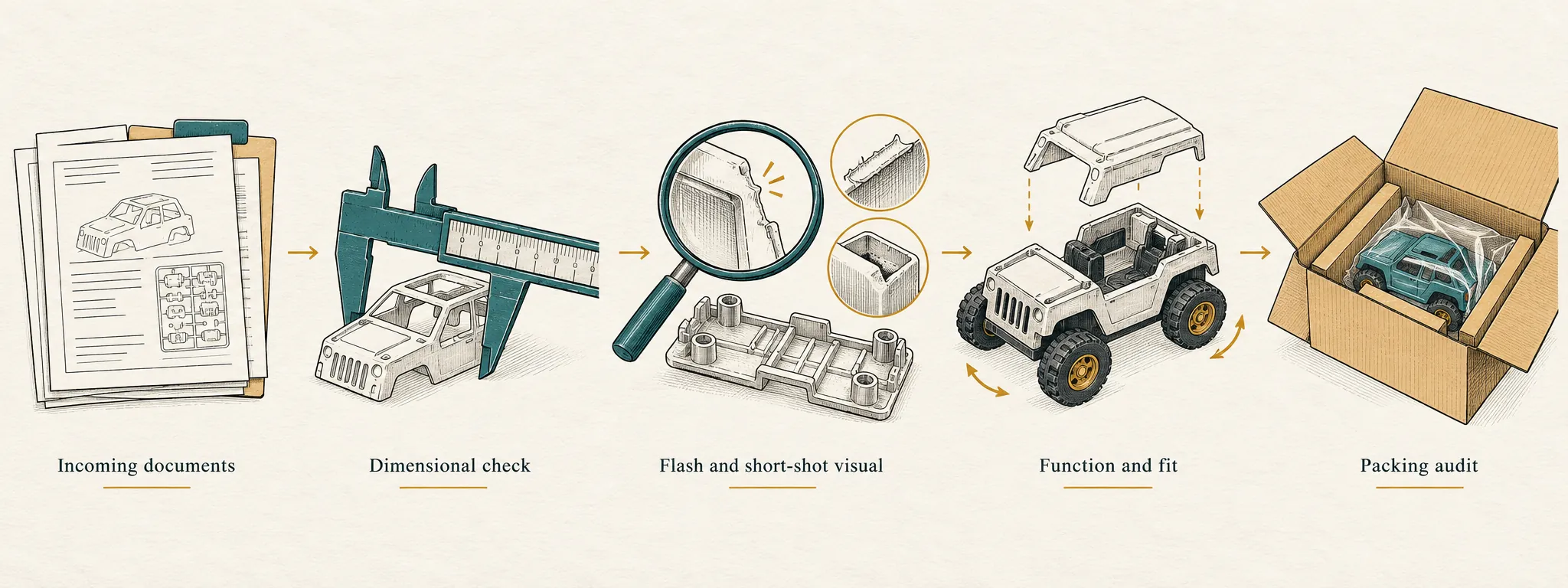
Plan toy lead time as two linked schedules: sample development through written approval, and bulk production from explicit release through final inspection and packing. For each SKU, require dated milestones, a named owner, the working-day or calendar-day basis, and a documented handoff. Do not treat a sample-making estimate as a factory completion promise. First compare the physical sample with the written specification; retain the approved reference only after approval, then use it alongside specifications and change records for bulk checks.
Define each endpoint precisely. “Sample ready” might mean ready for dispatch, not received and approved by the buyer. “Production complete” might mean assembly finished, not inspected and packed. Neither phrase, by itself, establishes a delivery date.
Which timing elements belong in the sample and bulk columns?
| Written specification, design, and artwork | Sample column: agree function, materials, dimensions, finish, and packaging requirements before making the approval sample. Bulk column: freeze the production revision and record subsequent changes. Owner: buyer product approver and supplier development lead. Calendar basis: each team's confirmed working calendar; record the dated file-release milestone. |
|---|---|
| Sample making | Sample column: record the trigger for starting, sample completion date, and dispatch-ready date separately. Bulk column: do not substitute this duration for manufacturing time. Owner: supplier sample lead. Calendar basis: confirm whether the quotation uses working days or elapsed calendar days. |
| Sample transport and buyer review | Sample column: separate dispatch, physical receipt, inspection, and written feedback dates. Bulk column: carry forward the approved decision, not the sample transit allowance. Owner: supplier dispatch coordinator and named buyer reviewer. Calendar basis: elapsed dates for transport; the reviewer's working calendar for approval. |
| Revision and reinspection | Sample column: schedule correction, replacement sample delivery where needed, and buyer reinspection as separate milestones. Bulk column: update preparation dates if the revision changes production requirements. Owner: supplier development lead and buyer approver. Calendar basis: confirm both teams' calendars and the feedback cutoff. |
| Safety-testing review | Sample column: identify the construction and revision submitted for the agreed testing. Bulk column: make closure of the agreed testing review a purchasing release condition. Owner: buyer compliance lead, supplier technical contact, and laboratory coordinator. Calendar basis: use the laboratory's confirmed receipt, test, and report dates; distinguish these from buyer review time. |
| Production authorization and preparation | Sample column: provide the signed sample decision and closed corrections. Bulk column: confirm production authorization, final specification, quantity, materials readiness, and scheduled start. Owner: authorized buyer signatory and supplier production planner. Calendar basis: record the release date and the factory's dated preparation and start milestones. |
| Bulk manufacturing and in-process checks | Sample column: supply the approved reference and controlled specification. Bulk column: schedule manufacturing, initial checks, in-process inspection, and any correction window. Owner: supplier production manager and quality lead. Calendar basis: confirm factory working days, closures, and the actual production-slot dates. |
| Final inspection and packing | Sample column: supply approved packaging artwork and presentation requirements. Bulk column: distinguish assembly completion, inspection, correction or reinspection, and packed-ready dates. Owner: supplier quality lead, packing lead, and buyer release authority. Calendar basis: date each milestone using the responsible team's calendar. |
How do supplier estimates become a usable SKU schedule?
Convert each estimate into actual dates using the responsible team's calendar and the event that starts its clock.
A supplier's published custom-plush example gives 7–10 working days for standard sample making while explicitly separating revisions, buyer review, sample transport, bulk production, and delivery. That is a supplier-specific sample estimate—not a general toy-industry production allowance. Custom Plush Toy Lead Times
Ask: “Does the clock start when you receive our drawing, when the specification is accepted, or when all required sample materials are available?” Then confirm weekends, holidays, closure dates, and approval cutoffs. Ten working days should not automatically become fourteen calendar days. Custom Plush Toy Lead Times
For each SKU, record whether it is a first order, an unchanged reorder, or a revised reorder. Compare the previous specification and change log before removing development stages. A changed material, function, finish, or package can reopen approval work even when the commercial product name stays the same.
Also record the revision rounds included in the plan, artwork and barcode readiness, ordered quantity, and whether the agreed testing covers the intended materials, components, and functions. Do not add every duration mechanically: approved parallel work may overlap, but the bulk start cannot precede its release conditions or the confirmed production slot.
What should the first sample inspection record contain?
| Identity and revision | Record the order reference, SKU or product identifier, sample identifier, specification and drawing revisions, artwork revision, sample receipt date, inspection date, and reviewer. Identify which control accessories and packaging components were inspected. |
|---|---|
| Function | Target: the agreed gesture-control commands, vehicle movements, lights, and music behavior. Observation: record the response to each specified command and the control method used. Failure signal: an agreed function is absent, intermittent, or different from the specification. Next decision: hold approval of the affected function and request correction plus reinspection. |
| Materials and components | Target: the specified housing, wheels, controls, and other agreed components. Observation: compare accessible parts with the component specification and supporting material records. Failure signal: a visible substitution or a mismatch between the sample and component records. Next decision: reconcile the construction and assess whether further verification is needed; appearance alone cannot establish material composition. |
| Finish and design | Target: approved color references, graphics, print position, surface finish, and agreed workmanship criteria. Observation: describe scuffs, uneven finish, print errors, or color differences against those references. Failure signal: a departure from the agreed requirement. Next decision: correct the finish or obtain explicit written acceptance of the identified deviation. |
| Dimensions | Target: dimensions, measurement points, and tolerances in the drawing. Observation: enter measured values using a suitable measuring tool. Failure signal: a value outside the agreed tolerance or a measurement method that does not match the drawing. Next decision: verify the measurement, then correct or formally resolve the dimensional discrepancy. |
| Agreed packaging | Target: the approved package type, product and accessory presentation, artwork revision, and barcode data where specified. Observation: compare the physical package and included items with the approved packing specification. Failure signal: the wrong artwork, missing agreed contents, or a presentation mismatch. Next decision: correct and recheck packaging before closing that approval condition. |
| Decision, accountability, and date | Record approved, correction required, or rejected; list each condition and its effect on production release. Enter the responsible approver's name and decision date. Assign a named correction owner and a dated resubmission or verification milestone. |
| Follow-up closure and retained reference | Link each discrepancy to the correction, reinspection observation, closure decision, responsible approver, and closure date. After approval, identify and retain the approved production reference and record its location alongside the final specification and change history. |
How should a sample discrepancy change the schedule?
A sample discrepancy should reopen the affected approval condition and its dependent dates, rather than disappearing into an unchanged bulk-production estimate.
Consider a hypothetical RC-car check: the written specification requires gesture steering, but the sample responds only to the handheld controller. Record the specified target as “gesture steering operates as agreed,” the observation as “no response to the specified gesture command,” and the decision as “correction required; functional approval withheld.” Assign the supplier's technical owner, agree a corrected-sample date, and have the named buyer approver enter the reinspection decision and closure date.
Determine whether the cause changes the component specification, operating instructions, packaging claims, or agreed testing scope. Revise only the milestones affected by that work, then obtain a refreshed production-slot confirmation. Do not assume the original slot remains available after the sample finish date moves.
Photographs can help identify a defect or revision, but a missing photograph alone does not invalidate an otherwise traceable physical review. Nor does a successful hand check establish regulatory safety. Keep the commercial sample decision and the review of applicable laboratory evidence separate.
What releases the sample into bulk production?
Release bulk production through a separate written authorization that identifies the approved construction, closes required conditions, and confirms the scheduled start.
Sample approval alone does not automatically start production. One supplier's handoff guidance separately identifies production authorization, final specification, quantity, agreed payment conditions, and the scheduled start; it also distinguishes appearance approval from product-safety requirements. Custom Plush Toy Lead Times
The release record should identify the order and SKU, approved sample and specification revisions, approved artwork, quantity, and agreed testing-review status. List any open conditions, their owners and closure dates, and whether each blocks production or permits a specifically defined activity. Enter the authorizing person's name, authorization date, and the supplier planner's acknowledgment of the dated bulk start.
Create and retain the approved production reference after approval—not before. It complements the written specification, inspection records, and authorized change history; it is not the sole valid basis for bulk inspection. A signed record supports traceability but does not, by itself, reveal an undisclosed construction change.
What should bulk inspection compare with the approved sample?
Bulk inspection should compare production against the final specification, retained approved reference, approved packaging, and authorized changes—not appearance alone.
Place checks at the initial-material or semi-finished stage, during production, and at finished-goods release. This staged sequence is also described in a supplier procurement checklist; agree the inspection coverage and acceptance criteria for the order rather than treating the sequence as a mandatory regulatory inspection standard. 7-Stage Toy Procurement
For the RC-car example, verify the specified control functions on production units, compare the documented component construction and finish, measure the defined dimensions, and check agreed accessories and packaging. Record the lot or production reference, inspection date, observed differences, disposition, and corrective-action owner.
If production differs from the approved requirements, identify the affected units and pause their acceptance while the difference is evaluated. Correction, segregation, reinspection, or a documented specification change may follow. Schedule the chosen action and its closure before confirming the revised packed-ready date.
Where can buyers shorten the schedule without hiding unfinished work?
Shorten waiting time and independent preparation first; do not remove an unresolved approval gate merely to preserve the original date.
Send complete design files, artwork, and barcode data early, and consolidate buyer feedback into one controlled revision. This reduces avoidable handoffs, but requires earlier decisions and disciplined change control.
Packaging preparation can overlap product review when its inputs are stable. The gain is less sequential waiting; the exposure is rework if dimensions, contents, or claims change. Authorize only the preparation that can proceed on the agreed information.
Testing may overlap final cosmetic review when the laboratory confirms that the tested construction represents the intended production version. A later change to test-relevant materials, components, or functions can require reassessment and further testing. Keep the agreed testing-review release condition intact.
Accept the schedule as a working plan only when every SKU has dated sample and bulk milestones, named owners, confirmed calendar bases, and explicit release conditions. Keep sample approval, production authorization, bulk completion, and packed-ready status as separate decisions. That separation makes the next delay actionable instead of merely surprising.
Next step