
TRADE DESK NOTE
Toy QC Checkpoints from Incoming Materials to Carton Loading
How to set toy QC checkpoints from incoming materials to carton loading, what to ask a factory, and which documents to demand before you place the order.
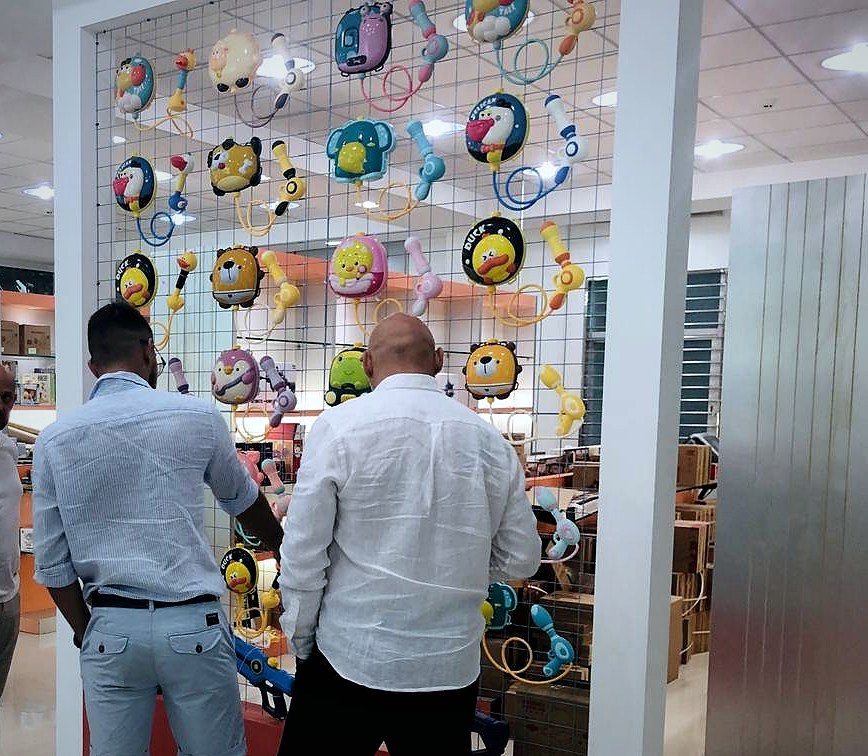
Toy quality control is a chain of release gates, not a final inspection you book the week before sailing: you set checkpoints at incoming materials, in-process production, final inspection and carton loading, and each one needs a stated check method, a pass limit, a frequency and a written action when it fails. If a supplier cannot name those four elements for the parts that actually carry risk on your SKU, that gap is your answer before you place a purchase order.
This page walks the checkpoint sequence a buyer can audit in a factory visit or a document request, then gives the questions that separate a factory with a real QC plan from one that only inspects at packing. The scope is deliberately concrete: what to check, what to ask, and what to hold. It does not hand out AQL levels or defect rates, because those come from your product drawing, your buyer specification and your safety review — not from a blog post.
What changed in the last 14 days
None found for this product. No recall, import-rule change or enforcement action specific to the toy configurations in this scope surfaced in the last 14 days of monitoring, so the checkpoint sequence below is the standard staged workflow rather than a reaction to a new event.
One dated item is worth noting because it touches test scope rather than inspection procedure: Commission Implementing Decision (EU) 2026/2032, published in the Official Journal on 14 September 2026, amends Implementing Decision (EU) 2023/740 on harmonised standards covering experimental sets for chemistry and related activities, formamide in foam toy materials, and certain chlorinated phosphorus flame retardants in toy materials. It is a standards update, not a new inspection regime. If your shipment contains foam parts, chemistry sets or chlorinated flame-retardant-treated material, ask your lab whether the applicable harmonised standard reference changed; if your products are plastic vehicles or building sets with no foam and no chemistry component, it does not change your checklist. Do not treat it as evidence that any supplier's goods have been tested.
What this shipment should do
For this shipment, the document to look at hardest is the one that ties a specific model to a specific test result — the product file, not the catalog page. A catalog record establishes catalog data only; it does not establish certification, infant suitability, licensing, stock or factory capacity, and you should treat every catalog field as unverified until the supplier reconfirms sample, current quote, age evidence and destination documents for that exact SKU.
On the US side, CPSC guidance places the Children's Product Certificate with the domestic manufacturer or importer as certifier, and the file must name the test-record holder, the manufacture, the testing and the accepted laboratory. It also says a CPC must describe the covered product sufficiently to match it to that product — a generic category name does not establish coverage of every catalog SKU under your RFQ. Separately, CPSC notes that laboratory acceptance is specific to the relevant safety rules and that one laboratory may not cover every required test, so match the lab's scope to the actual toy configuration rather than to a category label.
If the destination is the EU, European Commission guidance puts conformity assessment, the technical file, the EU declaration of conformity and affixing the CE mark with the manufacturer, while importers and distributors carry their own compliance responsibilities. Ask who holds the technical file and who affixes the mark. A catalog symbol alone is not evidence that the complete review was performed.
Then set the release gates. Before bulk production, freeze the current product name, SKU and model, intended age, destination market, bill of materials, component drawings, approved materials and suppliers, key dimensions and tolerances, approved colors, the approved physical sample, printing artwork, instruction manual, packaging specification, warnings and labels, and the relevant test reports. Version control is where shipments quietly go wrong: if Rev. D artwork is approved and the line is still running Rev. C, hold the batch even when the print looks clean.
At incoming materials, the question is not whether the resin or paint looks fine, it is whether the delivered lot matches the approved material code and supplier. Incoming checks should stop uncontrolled parts from entering the line. A non-conforming lot is quarantined, not consumed, because a bad material batch caught here costs less than the same batch caught in a finished unit.
In process, focus on the operations that repeat: first-piece comparison against the approved files and sample, glue seating and cure, fit and function, and content or version checks on printed and programmed items. Confirm whether the factory runs a pilot batch before scaling. This is the cheapest point to correct a defect, so ask for inline records rather than a promise.
At final inspection, defects should be sorted into critical, major and minor before inspection day, not argued about after a failure. Workmanship, label and marking checks, packaging and carton identity belong here. Keep in mind that selecting which units to inspect is not the same as deciding what each unit must prove: a sampling plan picks the units, your product-specific risk map defines the checks.
Carton loading is the last gate and the one buyers most often leave unwatched. Reconcile the reported lot quantity against the packed-carton count, confirm the carton marks and SKU identity, and check that the packed lot still matches the approved references. When a finding has no bounded cause, no corrective proof and no defined recheck population, hold the release.
Worked example (illustrative, not a real shipment): an order of roughly 12,000 plastic toys splits across two destinations, one in the US and one in the EU, with a color-box pack for the US and a polybag pack for the EU. Incoming material checks pass. First-piece assembly passes. Final inspection finds the carton mark on the polybag export cartons carries the wrong SKU, and the barcode scan at packing does not match the approved artwork revision. Nothing is wrong with the toy itself. The shipment still gets held at carton loading, because the packed lot no longer describes the approved product for that destination — and the fix is a repack and recheck of the affected cartons, scoped by which cartons were packed after the artwork change.
Checkpoints by stage: what to check and the red flag
| Pre-production: approved references frozen | Check method: compare BOM, drawings, artwork, sample and packaging revisions against the current file. Red flag: the line is running an older revision than the approved one. |
|---|---|
| Pre-production: test scope matched to the model | Check method: confirm the certificate or product file describes this model/SKU and the applicable rule references. Red flag: only a category name, or a lab scope that does not cover this configuration. |
| Incoming materials: identity and grade | Check method: supplier and material-code check per incoming lot. Red flag: no lot record, or material accepted without quarantine of a failed lot. |
| Incoming materials: paint, glue, magnets, small parts | Check method: batch and code check, specification check per lot. Red flag: substitution announced after the fact instead of approved before. |
| In-process: first piece and setup | Check method: compare the first units against approved files and sample. Red flag: production starts before a first-piece sign-off. |
| In-process: repeat operations (glue, fit, assembly) | Check method: patrol check at a defined frequency on the operations that repeat. Red flag: no inline records, only a final pass claim. |
| In-process: content, print and firmware version | Check method: master-file comparison, and 100% check if programming is automated. Red flag: version control handled by memory. |
| Final inspection: workmanship and severity sorting | Check method: visual check against the approved final sample with critical/major/minor agreed in advance. Red flag: defect categories negotiated after a failure. |
| Final inspection: set contents and labels | Check method: count and identify against the approved sample and packing plan. Red flag: missing pieces or wrong language on the retail pack. |
| Carton loading: quantity, marks, SKU identity | Check method: reconcile lot quantity with packed-carton count, verify marks and barcode/SKU. Red flag: cartons packed against a superseded artwork revision. |
| Change control at any stage | Check method: treat an unapproved change as a new release decision covering what changed, when, which reference is affected and which units could contain it. Red flag: a change with no recheck boundary. |
What to ask suppliers before you place the order
Send these as an RFQ checklist and score the replies. A factory with a working QC system answers with records and named responsibilities; one without answers with adjectives.
Which specific SKU or model does your certificate or product file cover, and can you send the file with the model description and the applicable rule references?
Who is the certifier of record, who holds the test records, and which accepted laboratory performed the testing? Does that laboratory's scope cover every safety rule applicable to this exact toy configuration?
If the destination is the EU, who holds the technical file and the EU declaration of conformity, and who affixes the CE mark?
What are your incoming-material, in-process, final-inspection and carton-loading checkpoints, and what check method, pass limit, frequency and failure action apply to each?
For each SKU in the RFQ, confirm the current sample, current quote, age evidence and destination documents — and fill the gaps in the catalog record. For example, on a 1:12 gesture-sensing RC drift vehicle the catalog snapshot records the material as not recorded, and on a 12V ride-on pickup the MOQ, carton quantity, size and weight are all recorded as none. Those blanks are not proof of anything; they are simply unanswered.
How do you handle an unapproved change — a paint batch, a magnet supplier, an age-grade revision, an artwork revision — and what recheck population do you apply?
Do you run a pilot batch before scaling, and can you share inline inspection records during production rather than only a final report?
What is your carton-level check at loading: quantity reconciliation, carton marks, SKU and barcode verification, and who signs it off?
One illustration of how the answers should look: a plastic building-block style set with a color box and a recorded carton quantity is straightforward to specify, while an RC vehicle carries battery-compartment closure, wiring and instruction questions that a plush or DIY model does not. Ask for the checkpoint list that fits the toy you are buying, not the factory's generic template.
FAQ
Does a passed lab test mean the shipment is ready to release?
No. Lab testing confirms a design is safe; QC confirms that the units rolling off the line match that design. A toy that passes its safety lab test can still leave the factory with workmanship, content or packing problems, which is why incoming, in-process, final and carton checks are separate gates rather than one report.
Is a CPC or CE mark on the catalog page enough evidence?
No. CPSC guidance says a Children's Product Certificate must describe the covered product sufficiently to match it to that product, and a generic category name does not establish coverage of every catalog SKU. Request the actual file and confirm the responsible parties, dates and model identity against your RFQ.
Can one laboratory cover all the tests my toy needs?
Not automatically. CPSC explains that laboratory acceptance is specific to the relevant safety rules and that one laboratory may not cover every required test. Match the applicable requirements and the laboratory scope to the actual toy configuration before you rely on a single report.
Where should I put third-party inspection in this sequence?
A pre-shipment inspection is a formal sampling inspection, often run by the buyer's QC agent or an independent third party, with pass, fail and corrective-action outcomes. It sits alongside your final inspection and carton loading gates; it does not replace laboratory safety testing, and it does not substitute for a product file that ties the model to its test evidence.
What is the single most useful thing to freeze before production?
The approved reference set: product name, SKU and model, intended age, destination market, BOM, component drawings, approved materials and suppliers, dimensions and tolerances, approved colors, the physical sample, artwork, instructions, packaging spec, labels and relevant test reports. Without a frozen reference, inspectors have nothing concrete to measure against and version drift becomes invisible.
Should I hold a shipment over a packaging or carton-mark issue?
Yes, when the packed lot no longer matches the approved product for that destination. A wrong carton mark or a barcode that does not match the approved artwork revision means the shipment does not describe the product you approved, and the corrective action is a scoped repack and recheck rather than a discount.
How do I handle a supplier that cannot state its AQL level?
Treat it as an open item rather than a deal-breaker, but do not release on it. Ask for the agreed sampling plan, the defect severity definitions and the documented corrective-action process. If the factory only checks at final packing, the cheapest correction point — incoming and in-process — is missing from the system.
Sources
Next step
Run the RFQ checklist above against your shortlist before you commit to a purchase order: ask each supplier for the four elements per checkpoint, the model-to-file match, and the carton-loading sign-off. If you want to start from a working reference, send us the SKU, destination market and target carton configuration, and we will come back with the sample, current quote, age evidence and destination document status for that exact model so you can compare it against the checklist.
Next step