
TRADE DESK NOTE
What to Include in a Wholesale Toy RFQ
Build a wholesale toy RFQ with SKU-level specifications, packaging, samples, open-item flags, and a supplier reply checklist for comparable quotes.
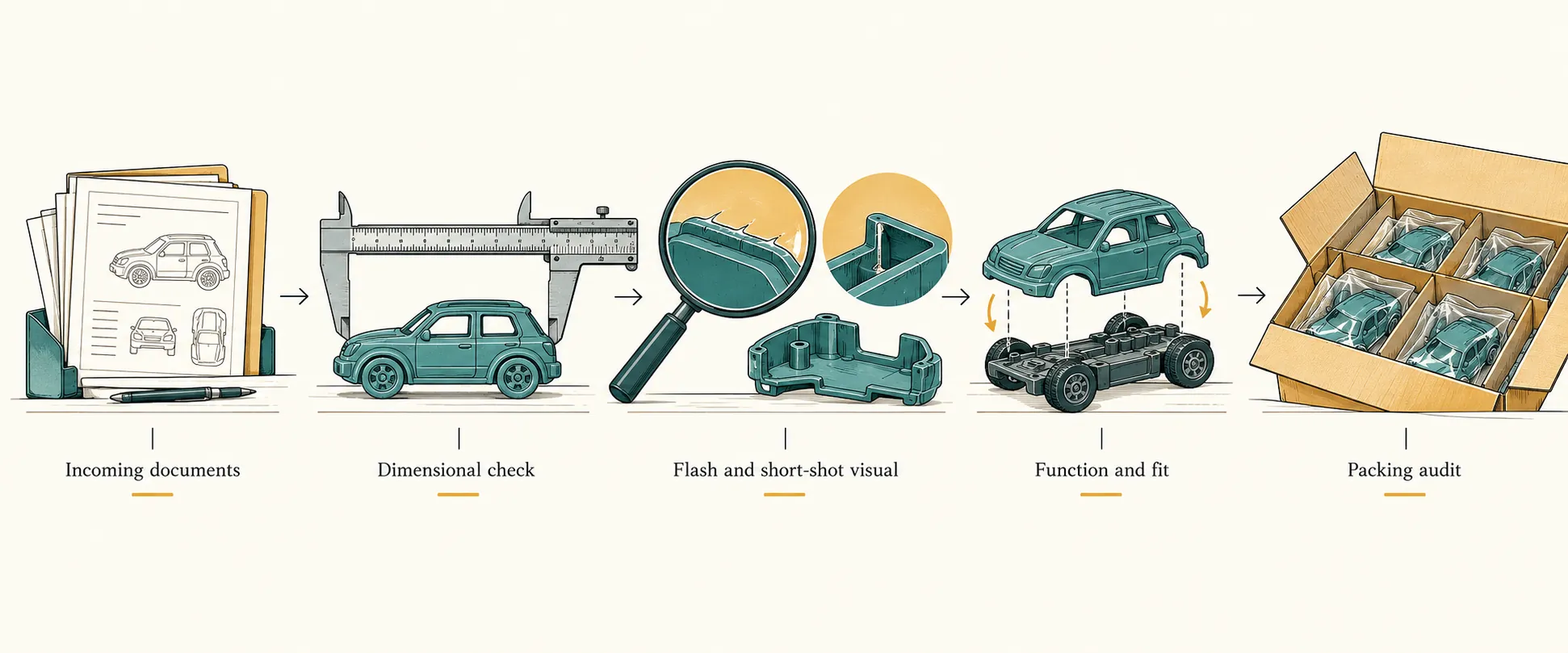
A wholesale toy RFQ should identify the exact product, quantity and assortment, branding, packaging, destination market, document requirements, approval steps, delivery milestone, and commercial basis. Give each SKU its own specification line, separate fixed requirements from open decisions, and require suppliers to disclose assumptions and exclusions. The practical goal is to compare prices for the same configuration—not a retail-box version against a bagged toy, or an undecorated sample against an approved branded product.
Which fields belong in a wholesale toy RFQ?
| RFQ identity and attachments | State the buyer/company, project name, RFQ reference, revision, issue date, response deadline, and contact person. List the drawings, photos, artwork, and specifications attached so the supplier can identify the version to price. |
|---|---|
| Product identity and configuration | Provide an exact supplier reference, product link, annotated photo, or clear description for each line item. Specify the required dimensions, materials by component, colors, functions, accessories, and power arrangement where relevant. Say whether a reference image defines the exact item or only the intended style. |
| Quantity and assortment | State the requested units for each SKU and the color/model split. Distinguish a firm quantity from a planning range. Ask the supplier to identify the minimum quantity for the requested configuration and the quantity basis used for pricing. |
| Branding and artwork | Attach the current artwork and state logo position, dimensions, colors, and the decoration method if fixed. If the method is open, ask for a named proposal rather than an unspecified branding allowance. |
| Unit packaging and labels | Define the bag, box, insert, display, or other required format. Include packaging language, barcode requirements, label content, artwork status, and retailer-specific instructions. Identify which components must be included in the unit price. |
| Master-carton information | Request units per carton, outer carton dimensions, gross weight, and carton marks for the quoted packaging configuration. Ask the supplier to identify estimates that still depend on final packaging approval. |
| Market, intended user, and channel | Name the destination country or countries, intended user and proposed age grade, and sales channel. Include relevant retailer or marketplace specifications rather than describing the destination only as global. |
| Testing and document scope | Attach the buyer/importer document specification and identify requested tests or standards, including editions where known. Ask what existing reports cover the quoted construction, what additional work is proposed, who will arrange it, and whether its cost is included. |
| Samples and approval | Identify the evidence needed before production: a blank sample, decorated sample, packaging proof, physical pre-production sample, or a defined alternative. State what each approval must establish and who can approve it. |
| Required dates | State whether the deadline means goods ready, shipment departure, or arrival at the named destination. Request separate sample/proof and production milestones, with the conditions that start each lead-time estimate. |
| Commercial basis | Request the quote currency, trade term and named place or port, and quote validity. If freight is requested, provide the destination details and ask the supplier to identify included and excluded delivery charges. |
How should fixed requirements and open items be marked?
Mark every consequential requirement as fixed, open for proposal, or subject to confirmation, and require the supplier to price an explicit base configuration.
A useful instruction is: “Fixed: attached product configuration and artwork position. Open: decoration method. Propose the method used in your base quote and identify any effect on minimum quantity, sampling, price, or timing.” Logo dimensions, color count, and the shape of the printing surface can influence the decoration method and sample cost. Custom Toy RFQ Template
Do not leave an undecided field blank. Write “packaging open—quote the specified base pack and show alternatives separately” or “destination awaiting confirmation—state the destination assumption used.” Explicitly identifying unresolved details follows the approach recommended in this RFQ preparation guidance. Toy RFQ Preparation
If the market or product construction remains open, treat the related document scope and price as provisional. Ask for substitutions and assumptions in a separate response column; silence is not acceptance of your specification.
How should an RFQ compare bagged and boxed packaging?
Ask every supplier to quote the same base packaging, then request the alternative as a separately identified configuration.
For example, suppose the product is fixed but an OPP bag and a window box are both under consideration. Write: “Base quote: OPP bag. Alternative: window box. Keep the product, quantity, assortment, and decoration unchanged. For each configuration, identify the included packaging and return its unit price, setup charges, carton quantity, carton dimensions, and approval requirements.” This is a comparison method, not a statement of available packaging or pricing.
The distinction matters because a switch from an OPP bag to a window box can change unit price, carton quantity, shipping volume, and available label space. Do not carry the bagged configuration’s packing figures into the boxed comparison. Toy RFQ Preparation
Choose a fixed packaging specification when direct quote comparison is the priority. Request separately priced alternatives when packaging is still a design decision. If one reply includes a box and another includes only a bag, obtain a scope correction before ranking them by unit price.
What sample and approval work should the RFQ include?
Specify the sample or proof needed to approve the quoted configuration, and ask suppliers to separate its cost and timing from bulk production.
A blank sample can support review of the undecorated product; it does not establish the finished logo or packaging. A decoration sample addresses the branded surface, while a packaging proof addresses the submitted packaging artwork and layout. Request a physical pre-production sample when your approval requires the assembled configuration rather than separate proofs. Select the stages needed for the project—not a compulsory sequence for every order. Custom Toy RFQ Template
For each required approval, identify the product and artwork revision, specified acceptance target, evidence to be reviewed, responsible approver, and required decision date. Ask the supplier to state what the sample represents and any differences from the proposed production version.
Use the resulting approval record to capture observations against the target, approval or rejection and any conditions, the approver and date, and closure of required corrections. That record supports traceability; it is not safety testing or proof that later production remained unchanged. Defining the approval route in the RFQ keeps this work visible in the quotation. Custom Toy Quote Checklist
What should the supplier return with the quotation?
| Product and quantity confirmation | Return the exact model/version priced, differences from the requested specification, requested quantity accepted, minimum quantity for that configuration, and any assortment restrictions. |
|---|---|
| Price and additional charges | State unit price, currency, quantity basis, and quote validity. Identify setup, tooling, decoration, sample, packaging, testing/document, and shipping charges as included, separate, or not quoted. |
| Branding and packing scope | Confirm the decoration method, artwork assumptions, unit packaging, inserts, labels, and master-carton details for the priced configuration. |
| Sample and production schedule | Identify each proposed proof/sample, its purpose, cost, and estimated timing. State production timing separately and identify the approvals or other conditions needed to start it. |
| Delivery basis | State the trade term and named place or port, destination assumption, and the delivery charges included or excluded if transport is quoted. |
| Document responsibilities and open items | Describe the proposed testing/document scope and responsible party. List deviations, assumptions, unresolved decisions, and items that could change the quoted price or schedule. |
How do you know the RFQ is ready to send?
An RFQ is ready when every price-sensitive field is either specified or explicitly open, and the supplier has clear instructions for returning a comparable quote.
Read the brief without relying on earlier emails: can the recipient identify each product version, quantities and mix, branding, packaging, destination, approval route, and required milestone? Check that attachment revisions match the RFQ and that one person owns follow-up questions. Resolve conflicting dates or drawings before sending.
Close with a direct return request: “Please quote against this RFQ revision, confirm each line item, identify all deviations and assumptions, separate additional charges, and list the decisions needed to finalize price and timing.”
When replies arrive, compare the same revision and base configuration first. Return mismatched scope for correction, assign an owner and due date to each open item, and record its resolution before treating the quotation as final.
Next step